Apply to Ivy League Colleges Guide for 2026

Getting into an Ivy League school is one of the most competitive academic pursuits a student can attempt, and the stakes feel higher than ever. This apply to Ivy League colleges guide was built to cut through the noise and give you a clear, honest picture of what it actually takes. We cover everything from academic rigor and updated 2026 testing policies to essay authenticity and strategic extracurricular depth. Whether you are a junior just starting to plan or a senior in the thick of applications, this guide gives you the framework to put your best foot forward.
Table of Contents
Key takeaways
Point | Details |
Holistic review is the reality | Admissions officers weigh character, contributions, and fit alongside GPA and test scores. |
Testing requirements shifted in 2026 | Harvard, Yale, Brown, Dartmouth, and Cornell now require SAT or ACT scores for admission. |
Depth beats breadth every time | Two or three high-impact activities outperform a long list of clubs with no leadership. |
Authentic essays win | Admissions teams are trained to detect AI-generated content and will penalize generic writing. |
Start earlier than you think | Strategic profile building should begin in 9th or 10th grade, not senior year. |
Apply to Ivy League colleges guide: understanding the basics
The most important thing to understand about Ivy League admissions criteria is that no single number gets you in. These schools use a holistic review process that weighs character, contributions, and institutional priorities alongside your GPA and test scores. Think of your application as a puzzle piece. The school is not just looking for the most impressive piece. It is looking for the piece that fits the specific gap in their incoming class.
Institutional priorities matter more than most applicants realize. Schools actively seek geographic diversity, underrepresented backgrounds, students pursuing rare or underfunded majors, and first-generation college students. A student from rural Montana applying to study Slavic linguistics has a genuinely different profile value than a student from a competitive prep school in Connecticut applying to pre-law. That is not unfair. It is just how the puzzle works.
“Admissions decisions go far beyond numbers. Schools are building communities, not just enrolling transcripts.” — Top College Coach
Here is what schools are actively evaluating beyond your grades:
Academic potential: Are you pushing yourself in the classroom, or coasting?
Personal character: Do your essays and recommendations reveal someone with genuine values and perspective?
Community contribution: Have you made a measurable difference in your school, town, or field?
Institutional fit: Does your intended major align with a program the school wants to strengthen?
Demonstrated interest is another factor worth understanding. While not every Ivy tracks it formally, showing authentic engagement through campus visits, virtual info sessions, and knowledgeable application essays signals that you have done your homework and genuinely want to be there.
Your academic profile: rigor, testing, and transcripts
Your transcript is the foundation everything else is built on. High school transcript rigor is foundational to Ivy League applications. An A in AP Chemistry carries more weight than an A in standard Chemistry. Admissions officers know the difference, and they will look at the most challenging courses your school offers to see whether you enrolled in them.
Here is a snapshot of where the eight Ivy League schools stand on testing for 2026:
School | 2026 Testing Policy |
Harvard | Test required (SAT or ACT) |
Yale | Test flexible |
Princeton | Test optional |
Columbia | Test optional |
Brown | Test required |
Dartmouth | Test required |
Cornell | Test required |
Penn | Test required |
Standardized test requirements returned strongly for most Ivies in 2026. If your target school requires scores, treat the SAT or ACT as a serious component of your application. Aim for scores in the 75th percentile range for each school, which typically means 1500 or above on the SAT.
Your transcript trajectory also matters. An upward arc, where sophomore year grades improve into junior year, tells a compelling story. A downward slide in senior year raises red flags even if your overall GPA looks strong.

Pro Tip: If your school does not offer AP or IB courses, take dual enrollment classes at a local college. Admissions officers evaluate rigor relative to what your school provides, and dual enrollment shows initiative when AP is not available.
Building an angular extracurricular profile
Here is the myth that costs students every year: joining twelve clubs looks impressive. It does not. Two to three activities with national or international impact are preferred over a long list of passive memberships. This is what admissions professionals call the “Spike.” Your spike is the area where you have gone so deep, shown so much leadership, and created so much impact that you are genuinely exceptional rather than merely well-rounded.
Building a spike takes time and intentionality. Here is a practical framework for developing yours:
Identify your genuine passion. Not what looks good. What actually keeps you up at night thinking about it. Admissions officers can tell the difference between manufactured interest and real obsession.
Go vertical, not horizontal. Instead of joining the environmental club, start a regional coalition of high school environmental groups. Instead of volunteering at a hospital, design a research project with a physician mentor.
Create something original. Independent research, publishing papers, launching podcasts, or founding nonprofits demonstrate intellectual vitality and self-motivation that Ivy League schools prize deeply.
Document your impact. Numbers matter. “Grew the robotics team from 8 to 47 members and won the state championship” is a completely different statement than “participated in robotics.”
Pursue recognition strategically. National competitions, published research, and awards give admissions officers an external validation of your achievements that carries significant weight.
Pro Tip: Start building your spike no later than 9th or 10th grade. By the time you are writing applications in 11th or 12th grade, you want years of documented impact behind you, not a rushed six-month project.
Crafting essays and securing strong recommendations
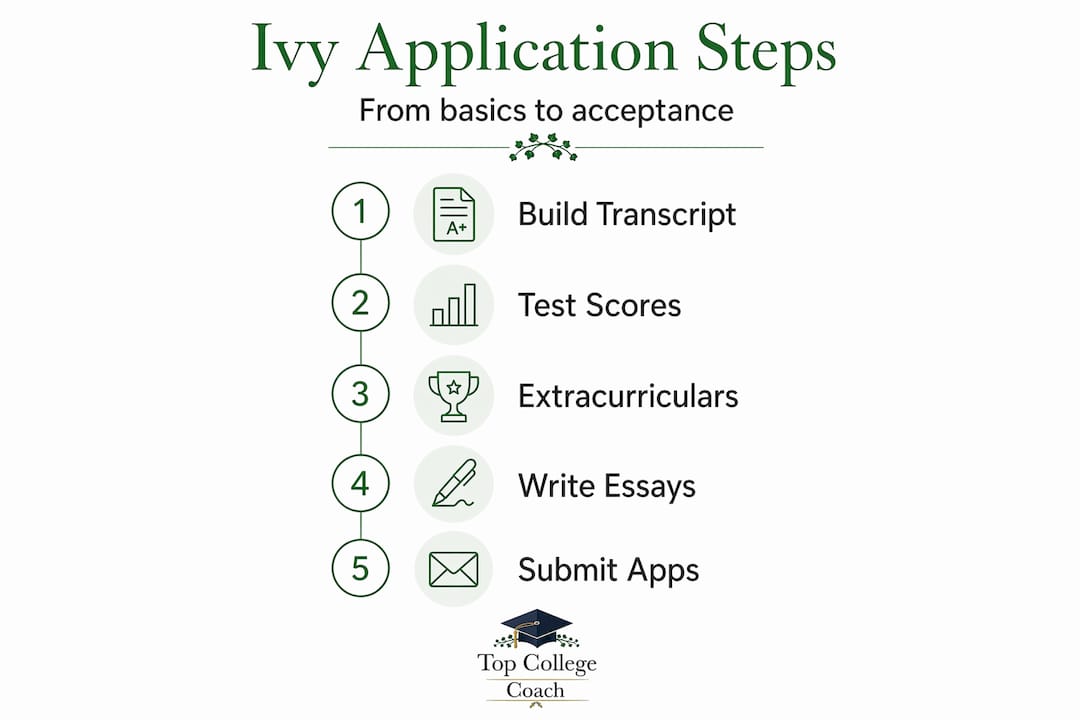
Your essays are the only place in the application where your actual voice comes through. And in 2026, that authenticity matters more than ever. Admissions teams are highly trained to detect AI-generated content and will penalize generic, robotic prose. The students who stand out write about failure, confusion, and growth with a specificity that no AI can replicate.
What makes an Ivy League essay work:
Hyper-specific anecdotes. Not “I learned leadership through soccer.” Instead: “The moment I realized I had been calling the wrong plays for three weeks and had to tell my team I was wrong.”
Vulnerability without victimhood. Share a real struggle. Show what you did with it. Admissions officers are not looking for perfect people. They are looking for self-aware ones.
A clear intellectual throughline. Your essay should make the reader feel like they understand how your mind works, not just what you have done.
A voice that sounds like you. Read it aloud. If it sounds like a formal report, rewrite it. If it sounds like you talking to a trusted adult, you are on the right track.
Recommendation letters deserve the same strategic attention. Recommendation letters should highlight specific personal achievements, hurdles overcome, and leadership examples rather than generic praise. Build real relationships with your recommenders over time. Give them a detailed brag sheet that includes specific stories, moments, and accomplishments they can reference. A letter that says “Sarah is one of the most curious students I have taught in 20 years, and here is exactly why” is worth ten letters that say “Sarah is a hardworking and dedicated student.”
Application execution and common pitfalls
Most Ivy League applications are submitted through the Common App or Coalition App. Both platforms are straightforward, but the execution details separate organized applicants from stressed ones. Check out the surprising changes in college admissions this year before you finalize your strategy, because the landscape has shifted in ways that matter.
Common mistakes that hurt otherwise strong applications:
Missing the Early Decision or Early Action deadlines. Applying early to your top choice school can meaningfully improve your odds at many Ivies.
Submitting generic supplemental essays. The “Why us?” essay is where students most often fail. Name specific professors, programs, research labs, and student organizations. Vague enthusiasm does not move the needle.
Neglecting the activities section. You have 150 characters per activity. Use every single one. Quantify everything you can.
Forgetting to prepare for interviews. Alumni interviews are not formalities. Treat them as real conversations with someone who will write a report that goes into your file.
Demonstrated interest through virtual info sessions and interviews can help in some admission contexts, particularly at schools that track engagement. Attend the virtual events. Sign up for information sessions. Ask thoughtful questions. These small actions build a record of genuine interest.
Working with expert guidance pays off in measurable ways. Specialized firms report acceptance rates 6 to 8 times higher than national averages for Ivy League and top 50 schools when students use expert strategy throughout the process.
My honest take on Ivy League admissions today
I have worked with hundreds of students through this process, and the pattern I see most often is not a lack of talent. It is a lack of strategic clarity combined with starting too late.
Here is what I have learned that most guides will not tell you: the students who get into Ivy League schools are rarely the ones who did everything right. They are the ones who did a few things with extraordinary depth and told the story of those things with honesty. I have seen students with 4.0 GPAs get rejected while students with 3.7s and a genuinely singular passion project get in. The difference was not the number. It was the narrative.
I have also seen families spend enormous energy trying to game the process, loading up on activities they think will look good rather than pursuing what genuinely drives the student. Admissions officers read thousands of applications. They recognize manufactured enthusiasm immediately. Authentic curiosity, even in an unusual direction, is far more compelling than a polished resume of expected achievements.
My advice to parents: your job is to support your student’s genuine interests, not to redirect them toward what you think an Ivy wants. And to students: start now, go deep, and tell the truth in your essays. That combination works.
— Randy Pryor
How Top College Coach can help you get in
At Top College Coach, we have spent years helping students turn strong potential into Ivy League acceptances. Our personalized admissions counseling covers every stage of the process, from building your academic and extracurricular profile in 9th grade to polishing your final essays the night before submission.
We offer profile building strategy, essay mentorship, interview preparation, and school list development tailored to your specific strengths and goals. Our counselors know what Harvard, Yale, Princeton, and the other Ivies are actually looking for because we have guided students through these doors successfully, year after year. If you are ready to stop guessing and start building a real strategy, schedule a free session with our team. One conversation can change the entire direction of your application.
FAQ
What GPA do you need to apply to Ivy League schools?
Most admitted students have GPAs of 3.9 or above on an unweighted scale, but rigor matters as much as the number itself. An A in AP or IB coursework carries more weight than an A in standard classes.
Are SAT or ACT scores required for Ivy League admissions in 2026?
Testing policies vary by school. Harvard, Brown, Dartmouth, Cornell, and Penn require SAT or ACT scores for 2026, while Columbia and Princeton remain test optional and Yale offers test-flexible options.
How many extracurricular activities should I list on my Ivy League application?
Quality beats quantity every time. Two to three activities with demonstrated leadership and measurable impact are more compelling than ten activities with surface-level involvement.
How do I write an Ivy League personal statement that stands out?
Write with hyper-specific anecdotes, genuine vulnerability, and a voice that sounds like you. Admissions officers are trained to detect AI-generated content, so authentic and personal writing is your strongest tool.
When should I start preparing my Ivy League application?
Ideally, profile building begins in 9th or 10th grade. By junior year, you should have a clear spike, strong academic rigor, and the foundation of your extracurricular narrative already in place.
Recommended
Comments