5 Minute Script to Ask Teachers for College Recs and One Page Packet
Updated: Sep 24

Ask teachers who have watched you grow, ideally from junior or senior year, and who can point to specific moments, not just grades. Do it in person or set up a short meeting, and aim for several weeks before your earliest deadline. Bring a one-page packet with your resume, brag sheet, and school list so the ask takes five minutes and the letter takes shape immediately.
TL;DR:
Teachers from junior or senior year who can detail specific moments of your growth are the best recommenders, especially those who can tell unique stories.
It is crucial to ask teachers at least four to eight weeks before your earliest college application deadline, avoiding periods of heavy grading or breaks.
Provide recommenders with a one-page brag sheet, a short resume, and clear instructions to help them write specific, memorable letters without guessing.
Always ask in person first, explaining why you chose that teacher and whether they feel able to write a strong letter, to ensure a genuine recommendation.
Handle follow-up carefully by providing submission details upfront, sending polite reminders, and promptly thanking teachers once the letter is submitted.
Table of Contents
Who Should You Ask for Teacher Recommendations?
The best recommender isn’t necessarily the teacher who gave you an A. It’s the one who can describe a moment when you argued a point in class discussion, rewrote an essay three times to get it right, or helped a struggling classmate understand a concept you’d already mastered. Admissions officers at selective schools read hundreds of letters that say “hardworking and reliable.” What sticks is the letter that tells a story they haven’t heard anywhere else in your application. MIT’s admissions office puts it plainly: the strongest letters are “storied” ones that go beyond grades and offer real anecdotes about character or growth.
That’s why a junior or senior-year teacher usually beats a freshman-year teacher, even if the freshman class was your favorite. Recency matters, and so does depth of contact. Colleges want to know who you are now.
Counselors and coaches have their place, but the rules differ:
Teachers should make up your primary recommenders, ideally two to four, since they’ve seen your intellectual habits up close over a semester or a year.
Counselors often write a required or optional letter that speaks to your overall trajectory and school context. Many colleges ask for this one separately.
Coaches or employers work well as a third or fourth letter when a school allows additional recommenders and the activity reveals something academics don’t, like leadership under pressure or discipline over multiple seasons.
Avoid asking a teacher who barely knows you, even if they’re popular or teach a subject you love, because a generic letter can quietly undercut an otherwise strong application.
Pick a few primary recommenders and keep some alternates in mind in case someone can’t commit. Never make a group announcement to your whole class asking “who’s willing to write me a letter.” It puts teachers in an awkward spot and reads as impersonal, which is exactly the opposite of what a memorable letter requires.
When to Ask: A Realistic Timeline for Recommendation Letters
Timing failures cause more recommendation problems than bad choices do. Here’s a sequence that keeps you ahead of every deadline instead of chasing one.
Spring of junior year: identify your likely recommenders and mention, briefly, that you’ll be asking them in the fall. This isn’t the formal ask, just a heads-up.
Late summer or the first weeks of senior year: make the formal request. This gives teachers the most lead time before grading season intensifies.
Four to eight weeks before your earliest deadline: treat this as the hard floor, not a suggestion. The University of Cincinnati recommends asking early and setting internal deadlines so recommenders never feel rushed.
Adjust for early action or early decision: if you’re applying early anywhere, that deadline, not your regular-decision deadline, sets your entire timeline. Ask for that letter first.
Avoid the two weeks around progress reports, midterms, or holiday breaks when possible. Teachers are buried in grading during those windows, and a request that lands then is more likely to get delayed or rushed.
A college application timeline checklist can help you map every deadline against this schedule. This is especially useful if you’re juggling scholarship applications alongside college deadlines. If you’re aiming at a professional program down the road, the lead times usually get longer. Some cycles reward applicants who submit as early as possible once the application window opens.
What to Prepare Before You Ask for a Recommendation Letter
Nothing helps a teacher write a specific, memorable letter faster than a packet that hands them the raw material. This isn’t about writing the letter for them. It’s about giving them what they need so they don’t have to guess.
Put together:
A one-page brag sheet listing your activities, awards, intended major, and two or three specific stories or moments you’d want mentioned, if relevant.
A short resume with academic highlights, leadership roles, and outside commitments like jobs or volunteer work.
A school and deadline list showing exactly where each letter needs to go and by when.
A transcript or grade summary, if the teacher asks for context on your academic record.
Submission instructions for each platform, whether that’s Common App, a school-specific portal, or a mailed letter with a stamped envelope.
The brag sheet does the heaviest lifting here. It’s not a resume restated in bullet points. Structure it around two or three concrete anecdotes and the specific qualities you’d want highlighted, like resilience after a tough semester or curiosity that showed up outside the syllabus. A detailed brag sheet template can save you from starting this from scratch.
Deliver the packet however your teacher prefers. Some want a printed copy handed over at the ask; others prefer a PDF or a shared Google Drive link they can reference while writing. Ask which they’d rather have instead of assuming.
Pro Tip: Start your brag sheet the summer before senior year, even before you’ve locked in your final recommender list. It’s far easier to add detail to an existing document than to write one from memory under deadline pressure.
Colleges that weigh essays and letters heavily are often looking for context they can’t get anywhere else in your file. A strong recommendation letter fills that gap, but only if the teacher has the material to fill it well.
How Exactly Do You Ask a Teacher for a Recommendation?
The ask itself is a short, professional conversation, not a big speech. Here’s how to structure it.
The in-person approach works best and is the method most guidance offices recommend first. Catch your teacher after class or during office hours, not in the hallway between periods when they’re rushing somewhere. A version of this script works for most situations:
“Hi, Mr. [Name], do you have a few minutes sometime this week? I’m applying to college this fall and I’d really like to ask if you’d be willing to write me a letter of recommendation. I chose you because of [specific reason], and I wanted to see if that’s something you’d feel comfortable doing.”
Watch how they respond. A quick, warm “of course” with follow-up questions about your plans is a good sign. Hesitation, a vague “let me think about it,” or a delayed response deserves attention, not pressure. That’s useful information, not rejection.
Before or during the meeting, bring:
Your one-page brag sheet and resume.
A list of schools and their deadlines.
A short explanation of why you’re asking this particular teacher.
An open question about whether they can write a strong letter for you, worded exactly that way.
That last point matters more than it seems. Asking directly whether someone can write a strong letter, rather than just any letter, gives them a graceful way to say no if they’re not the right fit. A lukewarm letter from a hesitant teacher can hurt more than a rejection helps.
The ask is a professional interaction. Explain why you chose that person, offer supporting materials, and give them an easy way to decline. That combination signals maturity and tends to produce a more thoughtful letter in return.
That framing comes directly from how career and admissions experts describe the request, and it applies just as well to a 17-year-old asking a chemistry teacher as it does to a job applicant asking a former manager.
If an in-person conversation isn’t possible, email works, but it needs to carry the same specificity. Two templates cover most situations.
Email Template A: Requesting a short meeting
Subject: Quick question about a recommendation letter
Hi Mr./Ms. [Name],
I’m starting my college applications this year and wanted to ask if you’d be willing to write a letter of recommendation for me. Would you have five or ten minutes this week to chat, either after class or during a free period? I’d love to explain a bit about why I’m asking you specifically and share some details that might help. Thank you for considering it.
Best, [Your name]
Email Template B: Formal written request with details
Subject: Recommendation letter request, [Your name]
Hi Mr./Ms. [Name],
Thank you again for agreeing to write a letter of recommendation for me. I’ve attached a brag sheet and resume with some background that might be useful, along with a list of the schools and deadlines I’m working with. My earliest deadline is [date], so I wanted to give you plenty of time. Please let me know if you need anything else from me, and thank you again for taking this on.
Best, [Your name]
Both templates leave room for the teacher to ask questions and confirm details, which is exactly the point.
Following Up and Handling Submission Logistics
Once a teacher agrees, your job shifts from asking to supporting. That means clear instructions and quiet, well-timed check-ins, not daily nudges.
Provide every submission detail up front: Common App recommender links, school-specific portal instructions, an email address, or a mailing address if a letter needs to go out on paper.
Send a polite reminder two to three weeks before the deadline, re-attaching your brag sheet and school list so the request stays visible on a busy desk. Capital One’s guidance on this timing lines up with what most guidance counselors recommend.
Send a second, brief check-in about one week out if you haven’t seen a submission confirmation yet, phrased as a helpful nudge rather than a demand.
Verify submission through the Common App portal or the school’s application tracker once the letter is in. If something looks stuck or a portal glitch appears, email the teacher directly and offer to help troubleshoot.
Send a thank-you note once every letter is submitted, and consider a short update in the spring letting them know where you landed.
A well-timed reminder isn’t nagging. It’s the difference between a letter that arrives on time and one that gets lost in a busy grading week.
What to Do if a Teacher Declines or Writes a Weak Letter
A “no” is rarely personal. Teachers decline for all kinds of reasons: an overloaded letter-writing season, limited familiarity with your work, or simple timing. Handle it this way.
Thank them for their honesty. A teacher who says no upfront just saved you from a weak letter you wouldn’t have known about until it was too late.
Move to an alternate recommender immediately rather than waiting to see if the first teacher reconsiders.
If a letter already submitted feels thin or generic, it’s usually too late to request a rewrite, but for future applications, you can ask a teacher directly whether they feel able to speak specifically to your strengths, before they commit.
Factor in timing: swapping recommenders even two weeks before a deadline is manageable if you move fast, but waiting until the final week limits your options considerably.
Pro Tip: If a teacher hesitates rather than flatly declining, treat that pause as useful information. Offer a quick meeting to fill in gaps, or take the hint and ask someone else. Pressuring a hesitant recommender rarely produces the letter you’re hoping for.
How Top College Coach Helps Students Get This Right
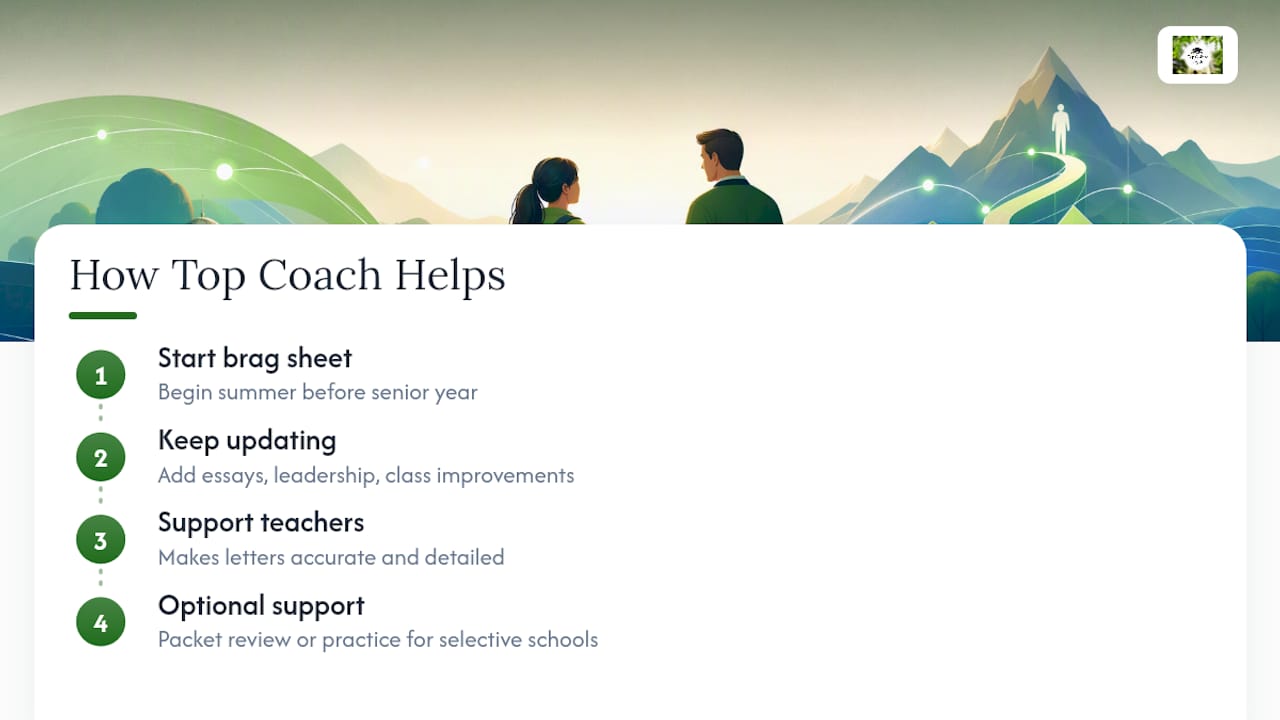
Counselors push students to build a brag sheet for a simple reason: teachers write better letters when they don’t have to reconstruct your junior year from memory. We tell students to start that document the summer before senior year and keep adding to it as things happen, a strong essay, a leadership moment, a hard class you turned around.
Most students can handle the ask on their own with the right preparation. Families sometimes bring in outside support when they want a second set of eyes on the packet itself or a practice run before the real conversation, particularly when a student is aiming at highly selective schools where every detail in the application needs to work together.
— Randy Pryor
If You Want a Second Opinion Before You Ask
A well-built brag sheet and a confident script go a long way, but for families targeting Ivy League or Top 20 schools, the recommendation strategy is just one piece of a much bigger application puzzle. Top College Coach works with students on exactly this kind of detail, reviewing brag sheets before they go to teachers, running mock “ask” conversations so the real one feels natural, and mapping how recommendation timing fits into a full application strategy alongside essays and activity lists.
This isn’t a replacement for the relationship you build with your own teachers. It’s support for families who want a former-admissions-officer’s eye on the details before deadlines arrive. If that sounds useful, you can start with Top College Coach and get a sense of where your application stands before you send a single letter request.
Where to Learn More About Recommendation Letters
A few sources are worth bookmarking, and worth sharing with your recommenders if it ever helps them write a stronger letter.
MIT Admissions explains exactly what admissions readers look for in a memorable recommendation letter, useful reading for both students and teachers.
University of Cincinnati offers a practical breakdown of timing and materials for the request itself.
DocuSign Learn covers the professional etiquette around asking, including how to offer an easy decline.
Capital One walks through submission logistics and reminder timing that apply directly to Common App and portal deadlines.
Sources
FAQ
How do you ask a teacher for a recommendation letter?
Ask in person when possible, explain specifically why you chose them, and offer a brag sheet or resume so they have material to work with. If an in-person conversation isn’t practical, a short, personalized email works, as long as it includes the same details.
Which teachers should you ask for recommendations?
Choose teachers from junior or senior year who know your work closely enough to describe specific moments, not just your grades. A counselor letter covers different ground and is often required or optional separately from teacher letters.
How do I write an email requesting a teacher’s recommendation letter?
Keep it short, specific, and attach your brag sheet, resume, and a list of deadlines. State your earliest deadline clearly so the teacher can plan around it, and thank them regardless of their answer.
Who are the best people to ask for a letter of recommendation?
The strongest choices are teachers who’ve seen consistent growth or a standout moment in your work, ideally within the last one to two years. Coaches or employers can add a third perspective when a school allows extra letters, but they shouldn’t replace your primary academic recommenders.
Recommended
Comments