Common Application Essay Guide for Students in 2026

Your common application essay is not a summary of your resume. It is not a list of accomplishments dressed up in paragraph form. And it is definitely not something a chatbot should write for you. Yet every year, thousands of students submit essays that feel generic, forced, or hollow because they misunderstand what admissions officers are actually looking for. This guide cuts through the confusion and gives you a clear, practical framework for writing an essay that sounds like you, tells a story only you could tell, and genuinely strengthens your application.
Table of Contents
Key takeaways
Point | Details |
Pick your story first | Choose a prompt that fits your authentic story, not the other way around. |
Fill the application gap | Use your essay to reveal something meaningful that grades and activities cannot show. |
Show, don’t summarize | Vivid, specific storytelling beats impressive but vague topic choices every time. |
Use AI carefully | AI can help you brainstorm and check grammar, but writing your essay for you is a serious risk. |
Revise with fresh eyes | Step away between drafts and seek trusted feedback before submitting. |
Understanding the 2026–2027 Common App essay prompts
Before you write a single word, you need to know what you are working with. Common App announced the 2026–2027 essay prompts on February 27, 2026, and the seven options cover a wide range of personal angles:
Background, identity, interest, or talent that is central to who you are
A challenge, setback, or failure and what you learned from it
A belief or idea you questioned and what came from that process
Gratitude toward someone whose influence changed your trajectory
An accomplishment or event that sparked personal growth
A topic that captivates you and how it shapes your thinking
A topic of your choice with complete creative freedom
That last prompt is more powerful than most students realize. If none of the first six feel like a natural fit for your story, the open topic gives you total flexibility. Do not overlook it because it feels less structured.
The most common mistake students make here is reading all seven prompts and then trying to reverse-engineer a story to fit whichever one sounds most impressive. Expert coaches consistently advise starting with your story and selecting the best-fitting prompt afterward. That sequence matters. When you force a story to match a prompt, the essay reads like a costume. When you find the prompt that naturally frames your story, the essay reads like a window.
Pro Tip: Read all seven prompts, then close the tab. Spend 20 minutes writing freely about moments in your life that felt significant. Then go back and see which prompt aligns with what you wrote.
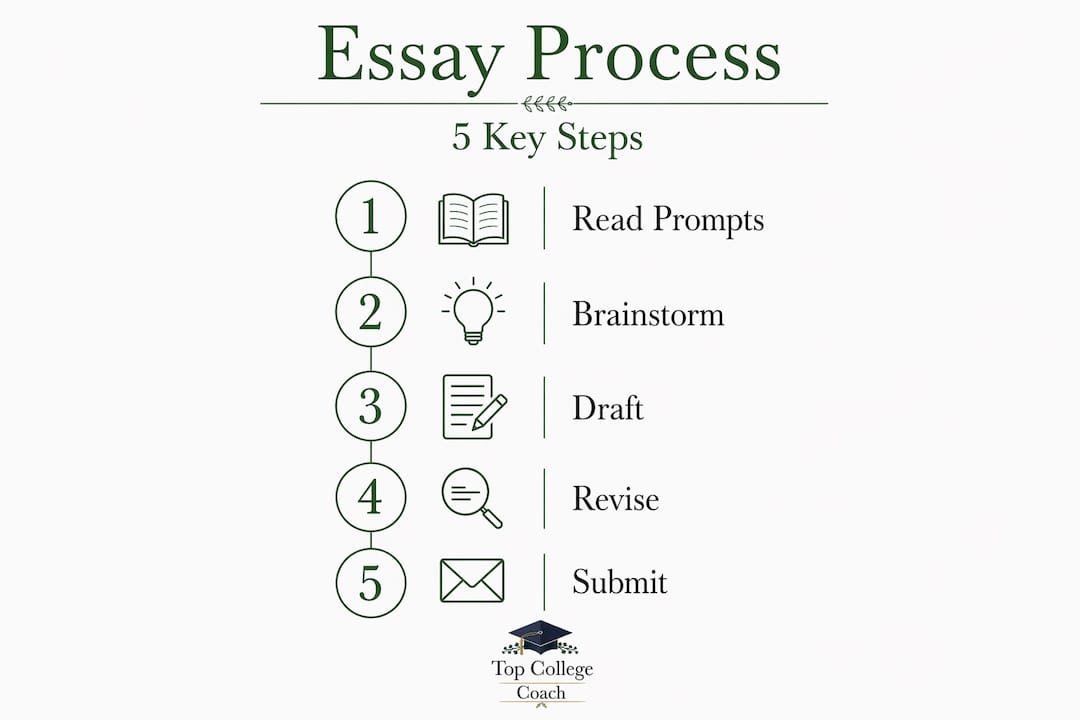
Brainstorming a topic that only you could write
Here is the truth about college essay common topics: the topic itself rarely makes or breaks an essay. A student who writes about losing a soccer game with genuine reflection and insight will outperform a student who writes about a mission trip abroad with surface-level observations. What matters is depth, not drama.
That said, your starting point should be strategic. We recommend what is often called the application gap test. Comparing your activities, grades, and recommendations to identify what personal insight is missing gives you a clear target. Ask yourself: after reading my entire application, what does an admissions officer still not know about me? Your essay should answer that question.
Here are four brainstorming techniques that actually work:
The best friend introduction. Imagine your closest friend is introducing you to someone new. What story do they always tell? What do they say captures who you are? That story is probably worth exploring.
The time-loss test. Think about activities where you completely lose track of time. Not because you are supposed to care about them, but because you genuinely do. That obsession often holds an authentic essay topic.
The small moment scan. Big dramatic events are not required. A quiet conversation with a grandparent, a failed experiment in your bedroom, a book you read three times. Small moments with big personal meaning make for the most memorable essays.
The values excavation. List five values you actually live by, not the ones that sound good on paper. Then ask which one you could trace back to a specific experience or person. That connection is your essay.
Avoid the following overused themes unless you have a genuinely fresh angle: sports injuries that taught you perseverance, volunteer trips abroad, and moving to a new school. These topics are not forbidden, but they require exceptional execution because admissions officers have read thousands of versions of them.
Pro Tip: Write your first brainstorm draft without editing. Give yourself 30 minutes and do not stop typing. The goal is to find the story that surprises even you.
Writing your essay: structure, voice, and authenticity
Once you have your topic, you face a structural choice. Most strong essays follow one of two formats.

The narrative structure tells a single focused story with a clear beginning, middle, and reflection. It works well for essays built around one defining moment or relationship. The montage structure weaves together several related scenes or images that collectively reveal a theme. It works well when your identity or passion cannot be captured in one event.
Either way, your opening line carries enormous weight. Strong essays have clear narrative arcs with engaging openings, vivid details, and genuine reflection. Drop the reader into a scene. Do not start with a dictionary definition, a famous quote, or a sweeping statement about the world. Start with something specific and sensory. “The smell of motor oil and burnt coffee is what I associate with my father” is more compelling than “My father taught me many important life lessons.”
“Admissions officers are not just reading for grammar. They are reading to understand who you are, how you think, and whether your voice is genuinely yours.”
A few writing practices that separate good essays from great ones:
Show, don’t tell. Instead of writing “I am resilient,” show the moment you kept going when everything said stop.
Use specific details. Names, places, sensory descriptions, and precise moments make your essay feel real and lived-in.
Write in your own voice. If you would not say it out loud to a friend, do not write it. Overly formal language signals that the essay is not really you.
Reflect, do not just narrate. Colleges want to see how you think, not just what happened. Every story needs a “so what” moment.
Revising for voice is just as important as revising for grammar. Read your essay out loud. If you stumble over a sentence, rewrite it. If a paragraph sounds like a brochure, cut it. Over-polishing can sterilize voice, and small stylistic choices that feel natural to you may actually enhance your essay’s personality.
Pro Tip: After your second draft, read your essay alongside your activity list. If the essay repeats what is already there, you have not yet found your real story.
Navigating AI tools ethically
AI is not going away, and pretending it does not exist does not help you. What matters is understanding the difference between using AI as a support tool and letting it replace your thinking entirely.
A study analyzing tens of thousands of essays found increased linguistic homogenization in essays submitted after AI tools became widely available in 2022. Lower-income students, who are more likely to rely on lower-quality AI tools, faced higher rejection rates as a result. That is a real and serious consequence.
Acceptable AI use | Problematic AI use |
Brainstorming topic ideas with prompts | Having AI write your first draft |
Checking grammar and spelling | Asking AI to rewrite your paragraphs |
Organizing an outline you created | Letting AI choose your tone and voice |
Getting feedback on clarity | Using AI-generated phrases as your own |
The Coalition for College Access is clear: appropriate AI use means brainstorming, outlining, and grammar checking your own ideas, not substituting personal content or voice. The essay must reflect your own thinking.
Admissions officers are trained to spot AI-generated text. More importantly, if you are interviewed or asked to discuss your essay, you need to own every word. If you cannot explain why you made a specific word choice or what a particular paragraph means to you, that is a problem.
Pro Tip: Ask yourself three questions before submitting: Did I write this? Does it sound like me? Could I talk about this for 10 minutes in an interview? If the answer to any of these is no, revise.
Final steps before you submit
Polishing your essay is not a one-afternoon task. Give yourself at least two to three days between your final draft and your submission date. Distance gives you perspective, and you will catch things on a fresh read that you missed when you were deep in the writing.
Here is a practical final checklist to work through:
Read it out loud one last time. Your ear catches what your eye misses.
Check the word count. The Common App essay limit is 650 words. Do not go over, and do not fall significantly short. Aim for 600 to 650.
Format for plain text. The Common App does not preserve fancy formatting. Use standard paragraph breaks and avoid special characters that might not transfer correctly.
Get feedback from someone who knows you. A school counselor, a mentor, or a trusted teacher can tell you whether the essay sounds like you and whether the story lands. Avoid feedback from people who will only say it is great.
Verify authenticity. Ask yourself honestly: does this essay reveal something real about who I am? Admissions counselors assess authenticity, clarity, storytelling strength, and reflection. All four need to be present.
For parents reading this: your role is to encourage, not to edit. The moment the essay starts to sound like you instead of your student, it has lost its most valuable quality. Ask questions, offer perspective, and trust the process.
My honest take on what makes these essays work
I have worked with hundreds of students on their college applications, and the pattern I see most often is this: the students who spend the most time trying to impress end up with the weakest essays. The students who are willing to be honest, even a little vulnerable, tend to write the essays that get remembered.
I have seen students write about their obsession with competitive eating documentaries, their complicated relationship with a second language, and the year they spent failing at chess. None of those topics sound impressive on paper. All of them produced extraordinary essays because the students wrote with genuine reflection and specificity.
My experience with AI is mixed. I have seen it help students organize scattered thoughts into a workable outline. I have also seen it flatten a student’s natural voice into something that reads like a press release. The risks of AI misuse in college essays are real, and I talk about them directly with every family I work with.
What I tell parents is this: your job is not to write a better essay. Your job is to create the conditions where your student feels safe enough to write an honest one. That means stepping back, asking good questions, and trusting that their story is worth telling exactly as it is.
The best common application essay you can write is not the most dramatic one. It is the most you.
— Randy Pryor
Work with Top College Coach on your essay
At Top College Coach, we have helped students gain admission to Ivy League and Top 20 universities by doing exactly what this article describes: finding the authentic story and helping students tell it well. Our personalized essay coaching goes beyond grammar checks. We help you identify what makes your application unique, develop a narrative strategy, and refine your voice across every draft.
If you are ready to take the guesswork out of the process, start with a free strategy session and see how our approach can work for your specific situation. You can also explore our full range of admissions counseling services to find the right level of support for your family.
FAQ
What is the word limit for the Common App essay?
The Common App essay has a 650-word maximum. Most counselors recommend writing between 600 and 650 words to show you can fully develop your story within the limit.
How do I choose which Common App essay prompt to use?
Start by identifying the story you most want to tell, then select the prompt that best frames it. Expert coaches advise choosing the prompt after you know your story, not before.
Can I use AI to help write my Common App essay?
You can use AI for brainstorming and grammar checks, but the Coalition for College Access is clear that the content and voice must be entirely your own. AI-generated essays risk homogenization and can hurt your admissions chances.
What topics should I avoid in my college application essay?
Overused themes include sports injuries, volunteer trips abroad, and moving to a new school. These are not forbidden, but they require an exceptionally fresh and reflective angle to stand out.
What do admissions officers actually look for in essays?
Admissions officers evaluate authenticity, clarity, storytelling strength, and reflection. They want to understand who you are and how you think, not just what you have accomplished.
Recommended
Surprising Changes in College Admissions This Year - Top College Coach
What Top Colleges Are Looking in Applications From Top College Coach
Top College Coach Reveals What Colleges Look for in Students: A Guide to College Admissions Criteria
College Admissions Counselor | Top College Coach | Ivy Admissions
Comments