College Counselor Outreach Explained for Parents in 2026

College counselor outreach is defined as the proactive, targeted engagement counselors use to guide students through every stage of college planning, from course selection to enrollment. The role of college counselor outreach explained simply is this: students who meet regularly with a school counselor are 7 percentage points more likely to enroll in college than those who do not. That gap is not trivial. It represents thousands of students each year who either find their path to higher education or lose it. A striking 86% of students report using information from their school counselor during their college search, and 84% find that support genuinely helpful. For parents and educators, understanding how this outreach works is the first step toward using it well.
What roles do college counselors play in student outreach?
Two distinct types of counselors shape the college admissions process, and confusing them costs families time and opportunity. High school counselors and admissions counselors serve fundamentally different functions. A high school counselor supports a student’s overall academic and personal development, advising on course rigor, college selection, financial aid, and application timelines. An admissions counselor, by contrast, works for a specific college and focuses on recruiting students to enroll there.
Understanding this distinction helps families direct their questions to the right person at the right time. When your student needs help building a college list or understanding the FAFSA, the high school counselor is the right resource. When your student wants to know whether a particular college values demonstrated interest or how to strengthen an application for a specific school, the admissions counselor at that institution is the better contact.
High school counselors carry out outreach through several concrete activities:
Academic planning: Advising students on course selection, AP or IB enrollment, and GPA trajectory to meet college admission standards.
College list building: Helping students identify schools that match their academic profile, interests, and financial situation.
Application guidance: Walking students through Common App requirements, essay prompts, and submission deadlines.
Financial aid advising: Explaining FAFSA completion, scholarship opportunities, and how to compare financial aid award letters.
Relationship building: Serving as the student’s advocate, including writing counselor recommendation letters that speak to character and potential.
On the admissions side, admissions counselors manage regional outreach by attending high school visits, hosting information sessions, reviewing applications, and conducting yield outreach through calls and events to convert admitted students into enrolled ones.
A growing specialty within admissions offices is the outreach coordinator role. Outreach coordinators focus specifically on recruiting underrepresented populations, including first-generation students, rural students, and low-income families, by partnering with community organizations to fill gaps that traditional recruitment pipelines miss.
Pro Tip: If your student is a first-generation college applicant, ask your high school counselor directly whether your school has a partnership with a college access program. These programs often provide free advising, FAFSA workshops, and campus visit opportunities that most families never hear about.
How does communication style affect student engagement?
The way a counselor communicates matters as much as what they say. Conversational, concise, and personalized messages produce higher student engagement than formal, institutional language. A short, friendly text that references a student by name and mentions a specific deadline gets read and acted on. A dense, formal email that reads like a policy document gets ignored.
This finding has real implications for how schools and counselors structure their outreach programs. The most effective formats include:
Text messages: Short, direct, and personal. Best for deadline reminders and quick check-ins.
Phone calls: Effective for complex conversations about financial aid or application strategy.
Emails: Useful for sharing documents, links, and detailed instructions, but only when kept brief.
In-person events: College fairs, campus visits, and information nights build trust and allow students to ask questions they would not put in writing.
Virtual sessions: Especially valuable for students in rural areas or those with scheduling constraints.
Short, natural, and specific communications consistently outperform formal, institutional phrasing in fast-paced admissions contexts. The counselors who build the strongest relationships with students are the ones who communicate like a trusted mentor, not like a bureaucratic office.
Timing also shapes outcomes. Outreach sent during peak stress periods, such as october and november of senior year, competes with dozens of other messages. Counselors who reach out earlier in junior year, when students are still forming their college plans, have more influence and face less noise.

Pro Tip: Parents can reinforce counselor outreach at home by asking their student one specific question after each counselor meeting: “What is the one thing you need to do before your next appointment?” That single habit keeps momentum going between sessions.
What is the measurable impact of counselor outreach on enrollment?
The evidence connecting counselor outreach to college enrollment is clear and consistent. Students who engage with their school counselor are meaningfully more likely to enroll in college, complete financial aid applications, and persist through the summer before freshman year.
Outreach Type | Key Outcome |
Regular counselor meetings | 7 percentage points higher college enrollment likelihood |
FAFSA-specific advising | Higher completion rates and financial aid access |
Summer outreach programs | Reduced “summer melt” among vulnerable students |
Wrap-around advising | Stronger enrollment gains than light-touch approaches |
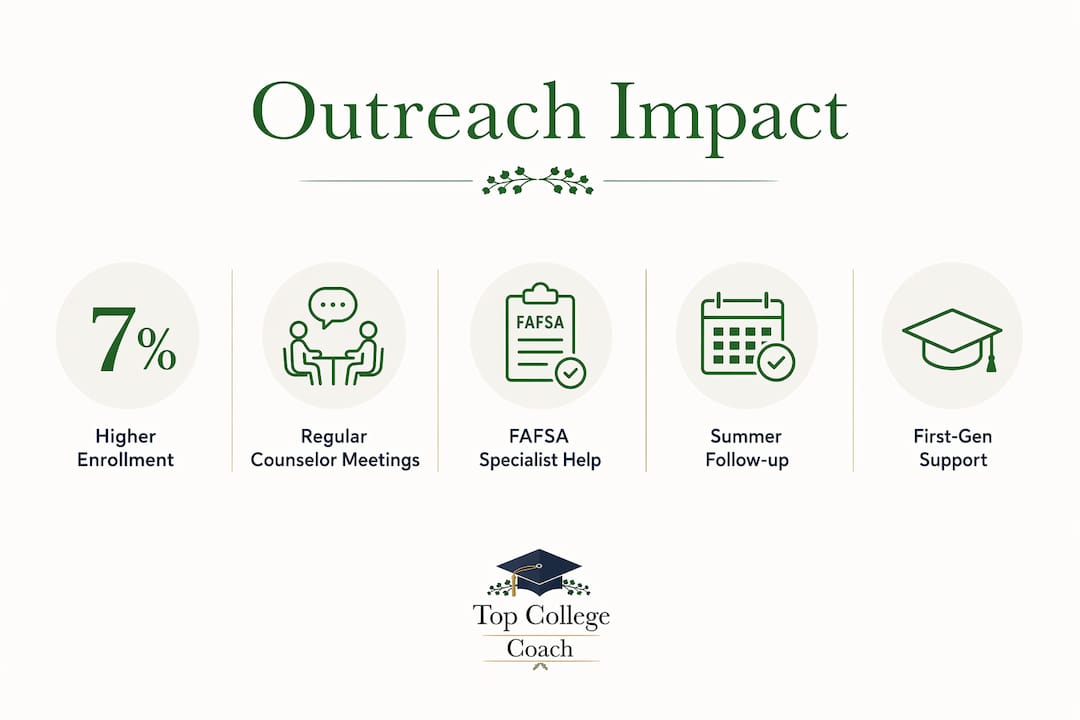
Intense, wrap-around advising that combines counseling with direct FAFSA help and technical assistance produces significantly better enrollment outcomes than light-touch advising. The difference is not just in the number of meetings but in the depth and specificity of support provided.
One of the most underappreciated threats to college enrollment is “summer melt,” the phenomenon where students who are accepted to college in the spring fail to enroll by fall. Sustained counselor-led summer outreach directly reduces summer melt by helping students navigate financial aid verification, housing deposits, and orientation registration during the months when school-based support disappears.
“Summer advising significantly benefits low-income, first-generation, and marginalized groups, helping them clear the final enrollment hurdles that derail college plans even after acceptance.”
The implication for families is direct. Staying connected to a counselor through the summer after senior year is not optional for students who face financial or logistical barriers. That connection is often the difference between enrolling and not.
Expert advising that combines counseling with technical support like FAFSA completion assistance has the highest success rates in increasing college enrollment. Advisors with specialized training in college access programs produce stronger outcomes than generalist counselors working alone.
How can parents and educators maximize counselor outreach?
Parents and educators play a direct role in whether counselor outreach reaches its full potential. The families who benefit most are the ones who treat counselor engagement as an ongoing partnership, not a one-time transaction.
Start early. Counselor relationships built in 9th or 10th grade give students more time to develop a strong academic trajectory and a clear college plan. Waiting until senior year limits options and increases stress.
Schedule regular meetings. Do not wait for the school to initiate contact. Parents should encourage their student to book appointments at least once per semester, and more frequently during junior and senior year.
Prepare specific questions. Students who ask specific questions and reference prior conversations stand out and get more useful guidance. “What should I do next?” is a weak question. “Given my GPA and my interest in engineering, which schools on my list are realistic reaches?” is a strong one.
Follow up on every recommendation. If a counselor suggests a scholarship program, a campus visit, or a test prep resource, act on it before the next meeting. Counselors invest more in students who follow through.
Advocate for underserved students. Educators who identify students unlikely to seek counselor help on their own should proactively connect those students with outreach resources. First-generation students in particular benefit from direct introductions to college access programs.
Educators can extend counselor reach by embedding college planning conversations into classroom settings. A history teacher who mentions the Common App essay in the context of a writing unit, or a math teacher who connects statistics coursework to college major exploration, reinforces the counselor’s message without adding to their workload.
Understanding what a college counselor does for your family is the foundation for using that resource well. Families who see the counselor as a partner rather than a gatekeeper get more out of every interaction.
Pro Tip: Before each college counselor meeting, have your student write down three specific goals for the appointment. This simple habit shifts the dynamic from passive to active and makes the counselor’s job easier and more effective.
Key Takeaways
Consistent, personalized counselor outreach is the single most reliable factor connecting students to college enrollment, especially for first-generation and underserved populations.
Point | Details |
Counselor contact boosts enrollment | Students with regular counselor meetings are 7 percentage points more likely to enroll in college. |
Two counselor types serve different needs | High school counselors guide overall planning; admissions counselors recruit for one institution. |
Communication style drives engagement | Conversational, concise outreach gets more student response than formal institutional messaging. |
Summer outreach prevents melt | Sustained counselor contact after senior year reduces the risk of accepted students failing to enroll. |
Early engagement multiplies impact | Families who start counselor relationships in 9th or 10th grade gain more time and better outcomes. |
What I’ve learned about counselor outreach that most families miss
After working with hundreds of families through the admissions process, I have seen one pattern repeat itself more than any other: families wait too long to engage with counselors, and then wonder why the process feels chaotic.
The counselors who change student outcomes are not the ones with the longest meetings. They are the ones who show up consistently, communicate in plain language, and treat every student as an individual with a specific story. The research confirms what I see in practice. Wrap-around advising, personalized communication, and sustained summer outreach all produce measurably better results than generic, infrequent contact.
What surprises most parents is that admissions counselors at colleges want to hear from students. Treating admissions counselors as partners rather than gatekeepers is not just good advice. It is a documented strategy for standing out in a competitive applicant pool. The families who teach their students to engage intentionally, reference prior conversations, and ask specific questions give their students a real advantage.
The biggest misconception I encounter is that counselor outreach is something that happens to students. The families who succeed treat it as something they actively participate in. That shift in mindset, from passive recipient to active partner, is where the real benefit of college counseling lives.
— Randy Pryor, Founder of Top College Coach
How Top College Coach helps families get the most from college advising
Knowing that counselor outreach matters is one thing. Having an expert in your corner who knows how to use it is another.
Top College Coach works with families across the country to build personalized college admissions plans that account for every stage of the outreach process, from freshman year course planning to senior year enrollment. Our team has a proven track record of helping students gain admission to Ivy League and Top 20 universities, and our admissions counseling services are built around the same principles this article covers: early engagement, specific communication, and sustained support through enrollment. If you want to understand exactly how counselor outreach fits into your student’s college plan, we are ready to help you build that plan with confidence.
FAQ
What is college counselor outreach?
College counselor outreach is the proactive engagement counselors use to guide students through college planning, including advising on applications, financial aid, and enrollment. It includes calls, texts, emails, events, and in-person meetings tailored to each student’s needs.
How does counselor outreach affect college enrollment rates?
Students who have regular contact with a school counselor are 7 percentage points more likely to enroll in college than those who do not. Sustained outreach, especially during the summer after senior year, also reduces the risk of accepted students failing to enroll.
What is the difference between a high school counselor and an admissions counselor?
A high school counselor supports a student’s overall academic and personal development across multiple colleges. An admissions counselor works for one institution and focuses on recruiting and enrolling students at that specific school.
When should families start engaging with a college counselor?
Families should begin building a counselor relationship in 9th or 10th grade. Early engagement gives students more time to strengthen their academic profile and develop a realistic, well-matched college list before the pressure of senior year applications begins.
How can parents support effective college counselor communication?
Parents can encourage their student to schedule regular appointments, prepare specific questions before each meeting, and follow through on every counselor recommendation. Treating the counselor as a long-term partner rather than a one-time resource produces the strongest results.
Recommended
Comments