College Admissions Counselor: Your 2026 Family Guide

A college admissions counselor is a professional advisor who guides students and families through every stage of the college application process, from building a balanced school list to crafting an authentic personal statement. The role goes far beyond paperwork. A skilled counselor helps students understand themselves better, present their genuine story, and find schools where they will truly thrive. At Top College Coach, we have seen firsthand how the right guidance changes outcomes, especially for students aiming at Ivy League and Top 20 universities.
What does a college admissions counselor do?
A college admissions counselor manages the full arc of the application process through a structured, multi-month or multi-year partnership. The work covers six core service areas, each building on the last.
Building a balanced college list. A strong list includes reach schools, target schools, and likely schools. The goal is a realistic spread that matches a student’s academic profile, interests, and financial situation. We help families choose the right colleges based on fit, not just rankings.
Creating an application timeline. Deadlines for Early Decision, Early Action, and Regular Decision vary widely. A counselor maps out every milestone, from requesting transcripts in September to submitting final applications in January. Families who follow a structured admissions timeline avoid last-minute scrambles.
Essay feedback and coaching. Students applying to 15 schools with early rounds write 50 to 70 supplemental essays, typically 150–300 words each. That is a significant writing load. A counselor reviews drafts, asks probing questions, and pushes students toward specificity. At Top College Coach, every student works with an award-winning writer who coaches the student in writing compelling narratives that only that student can create.
Standardized testing strategy. Approximately 80% of four-year colleges are test-optional in 2026. That statistic does not mean testing is irrelevant. At highly selective schools, a strong SAT or ACT score still provides a measurable competitive advantage.
Academic course planning. Admissions officers at selective schools evaluate grades within the context of each school’s curriculum. A 3.8 GPA in the most rigorous available coursework is generally viewed more favorably than a 4.0 in standard courses. Counselors advise students on course selection well before senior year.
Post-decision support. The process does not end at submission. Counselors stay engaged through deferrals, waitlist letters of continued interest, financial aid comparisons, and final enrollment decisions.
Pro Tip: Ask any counselor you are considering how they handle waitlist situations. Their answer reveals whether they offer real, ongoing support or just help with the initial application.
How to choose an ethical and effective admissions counselor

Knowing what to look for protects your family and your student.
Signs of a strong counselor:
They are genuinely interesting in helping students discover where they genuinely thrive rather than chasing prestige for its own sake.
They ask deep questions about a student’s interests, values, and learning style before recommending any schools.
They give honest feedback on reach schools without dismissing a student’s ambitions.
They have verifiable experience, real client reviews, and a track record at selective institutions.
They explain what they cannot do, including writing essays, concealing a student’s identity, or guaranteeing admission.
Red flags to avoid:
Any counselor who promises a specific admissions outcome. No ethical professional can guarantee acceptance anywhere.
Advisors who suggest “gaming the system” through manufactured activities or misleading application narratives.
Counselors who write application essays on behalf of students. This crosses an ethical line and puts students at risk.
No verifiable client results or references.
Pro Tip: When interviewing a potential counselor, ask: “Can you walk me through how you helped a student with a profile similar to mine?” A specific, detailed answer signals real experience. A generic answer signals a sales pitch.
Families searching for a qualified college counselor should also check whether the counselor stays current with shifting admissions policies, including test-optional changes and new supplemental essay prompts released each cycle.
What can an independent counselor do that school counselors cannot?
School counselors are dedicated professionals, but structural limitations affect what they can realistically provide. Independent education consultants fill the gap with individualized attention that most public school counselors simply do not have time to offer.
Area | School counselor | Independent counselor |
Caseload | Often 300+ students per counselor | As few as 10-12 students |
Availability | School hours, academic year | Evenings, weekends, and summers |
Essay coaching | Limited or none | Detailed, multi-draft feedback |
College list depth | General guidance | Personalized research per student |
Admissions trend updates | Varies by school resources | Continuous professional development |
Post-decision support | Minimal | Waitlist, deferral, and aid advising |
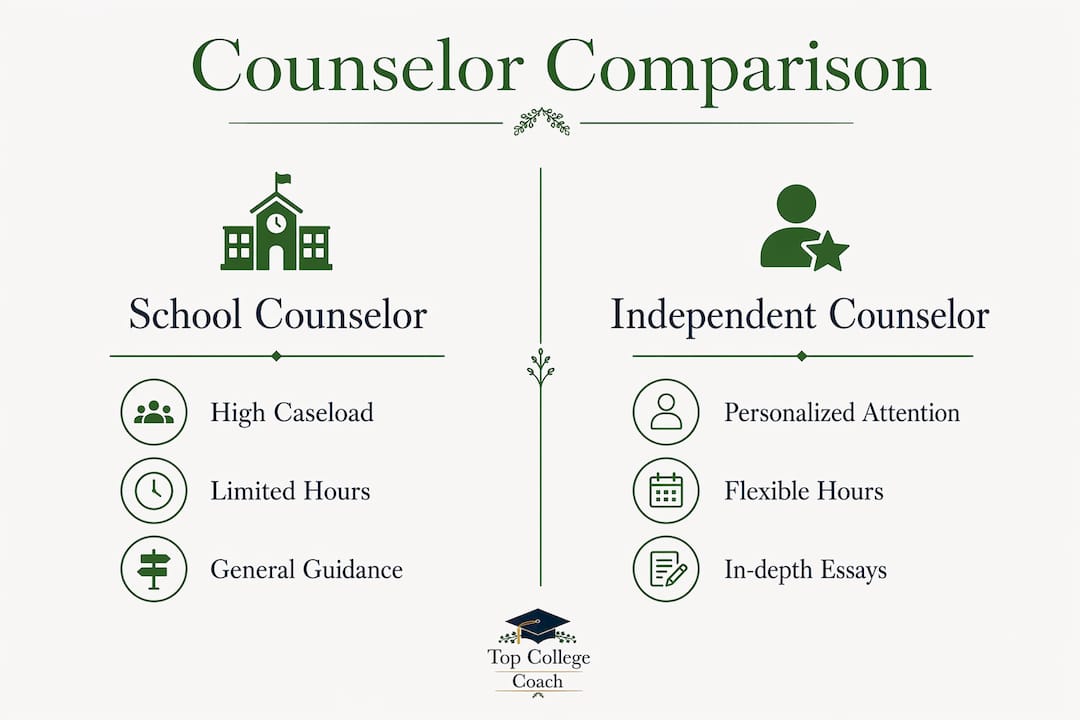
The summer before senior year is one of the most productive periods for college application work. School counselors are largely unavailable during those months. An independent counselor works through the summer, helping students draft essays, finalize their list, and prepare for interviews before the school year begins.
Strong academic recommendations also require relationship-building. Two teacher recommendations plus a counselor letter are standard at selective schools, with specific anecdotes valued over generic praise. An independent counselor coaches students on how to cultivate those relationships and what to communicate to recommenders.
How to maximize your partnership with a counselor
Getting full value from a counseling relationship requires active participation from both the student and the family. Passive clients get generic results.
Be honest about your goals and concerns. Admissions representatives and counselors alike emphasize that open communication leads to better-fit outcomes. If a school feels wrong, say so early.
Follow the timeline your counselor sets. Missed deadlines create compounding stress. Completing tasks on schedule keeps every option open.
Use feedback to grow, not just to edit. When a counselor pushes back on an essay draft, the goal is authenticity, not criticism. Admissions officers read thousands of essays and respond to stories that feel real and specific, not polished and generic.
Build rapport early. Early relationship-building with counselors smooths the entire process and builds the trust needed for honest conversations about reach schools and realistic options.
Bring your own voice to every meeting. A counselor’s job is to amplify who you already are, not to manufacture a profile. Students who arrive with genuine curiosity and self-awareness get the most out of every session.
Balance counselor advice with family values. The final college choice belongs to the student. A good counselor presents options and analysis. The decision reflects the student’s own priorities.
The role of a college counselor is most powerful when students treat it as a thinking partnership, not a service they consume passively.
Key takeaways
A college admissions counselor delivers the most value when students engage honestly, follow structured timelines, and prioritize authentic storytelling over manufactured perfection.
Point | Details |
Core services span the full process | Counselors cover list-building, timelines, essay coaching, testing strategy, and post-decision support. |
Ethics define quality | Avoid any counselor who promises outcomes or offers to write essays on a student’s behalf. |
Independent counselors fill real gaps | They offer availability and depth that school counselors cannot provide due to caseload limits. |
Authenticity beats perfection | Admissions officers prefer specific, genuine stories over polished but generic applications. |
Active participation drives results | Students who engage honestly and follow timelines get measurably better outcomes from counseling. |
Why I think the prestige chase is the biggest mistake families make
After years of working with students and families at Top College Coach, the pattern I see most often is this: a family arrives focused entirely on a short list of brand-name schools, and the student’s actual interests, strengths, and learning style are almost an afterthought.
The admissions process has grown more complex every cycle. More applications, more test-optional policies, more supplemental essays, and more uncertainty at the top schools. That complexity pushes families toward counselors who promise certainty. The problem is that certainty is not something any honest counselor can sell.
What I have found actually works is the opposite of prestige chasing. Students who do the hard work of self-reflection, who can articulate what genuinely excites them and why, write essays that feel real and unforgettable. Those are the applications that move admissions readers. A student obsessed with getting into a single school often produces a generic application trying to match a perceived ideal. A student focused on finding the right fit produces something specific and memorable.
My advice to every family: treat your counselor as a partner in self-discovery, not a shortcut to a famous name on a sweatshirt. The schools where students thrive are not always the ones with the highest rankings. The best outcome is a student who arrives on campus ready to contribute, not one who barely survived the application process chasing someone else’s definition of success.
— Randy Pryor
Top College Coach is ready to support your family
Top College Coach brings a proven track record of helping students gain admission to Ivy League and Top 20 universities, with 5-star reviews from families across the country. Based in Orlando, Florida, we offer personalized counseling that covers every stage of the process, from building your college list to refining your personal statement and navigating financial aid decisions.
Whether you are a rising junior starting early or a senior facing a tight deadline, our team provides the focused, one-on-one admissions counseling support your student deserves. We work evenings, weekends, and summers because the college application process does not follow a school calendar. Reach out to Top College Coach today to schedule a consultation and take the first confident step toward the right college.
FAQ
What does a college admissions counselor do?
A college admissions counselor helps students build a balanced college list, create application timelines, refine essays, and navigate decisions around testing, financial aid, and waitlists. The role covers the full process from early planning through final enrollment.
How is an independent counselor different from a school counselor?
Independent counselors provide one-on-one attention, work outside school hours including summers, and offer detailed essay coaching that school counselors rarely have time to provide given large student caseloads.
Can a college admissions counselor guarantee admission?
No ethical counselor can guarantee admission to any school. Any advisor who promises a specific outcome is a red flag and should be avoided.
When should a student start working with a college admissions counselor?
Starting in sophomore or junior year gives students the most time for course planning, test preparation, and essay development. Rising seniors can still benefit significantly from counseling if they begin in the summer before senior year.
What questions should I ask when hiring a college admissions counselor?
Ask about their experience with students at your academic level, how they handle waitlists and deferrals, and whether they can share specific examples of past client outcomes. Clear, detailed answers signal genuine expertise.
Recommended

Comments