How the Ivy League Admissions Process Works in 2026

If you believe getting into Harvard, Yale, or Princeton is simply a matter of straight A’s and a perfect SAT score, the reality of how the Ivy League admissions process works will surprise you. These schools have moved far beyond academic metrics alone, operating a deeply holistic selection process that weighs character, narrative, intellectual curiosity, and real-world impact alongside grades and test scores. With acceptance rates dropping to around 5% for the Class of 2028, understanding every layer of this process is no longer optional. It is the foundation of a serious application strategy.
Table of Contents
Key Takeaways
Point | Details |
Holistic review is standard | Every Ivy League school evaluates academics, essays, recommendations, extracurriculars, and character together. |
Curriculum rigor matters most | 97% of selective schools rate course rigor and grades as important, outweighing test scores significantly. |
Early Decision boosts odds | Brown’s ED acceptance rate of 14.58% dwarfs its Regular Decision rate, making timing a real strategic factor. |
Depth beats breadth | Ivy League schools actively seek applicants with a defined “spike,” not generic well-roundedness. |
Scattershot applications hurt you | Applying to all eight Ivies signals a lack of genuine interest and weakens each individual application. |
How the Ivy League admissions process works: the holistic model
The formal term for what Ivy League schools practice is holistic admissions review. That means no single factor makes or breaks your application. Instead, admissions officers read each file as a complete picture of a person, not a scorecard.
Here is how that picture gets assembled, according to Common Data Set analysis of factors:
Curriculum rigor and GPA: Rated important by 97% of selective institutions. The hardest classes you can take, and how well you perform in them, carry the most weight.
Essays: Significant for 85% of selective schools. They reveal voice, maturity, and whether you think deeply.
Extracurricular activities and character: Weighted by 76% of schools. Impact and leadership matter more than sheer quantity.
Recommendations: Considered by 72% of schools. Specificity and insight from teachers make the difference.
SAT/ACT scores: Rated important by only 36% of selective schools. For Fall 2026, six of the eight Ivies require standardized testing, with Columbia remaining test-optional and Princeton test-optional through the 2026-27 cycle.
Demonstrated interest: Carries weight at only about 6% of selective schools. Do not over-invest in campus visit tours at the expense of essay quality.
Pro Tip: Do not obsess over demonstrated interest signals like email opens or virtual tours. Redirect that energy toward writing essays that reflect genuine intellectual passion. That investment pays off far more.
The shift back to required testing at most Ivies after the pandemic-era test-optional experiment signals that scores matter, but they matter less than your transcript. Think of your score as a floor, not a ceiling.
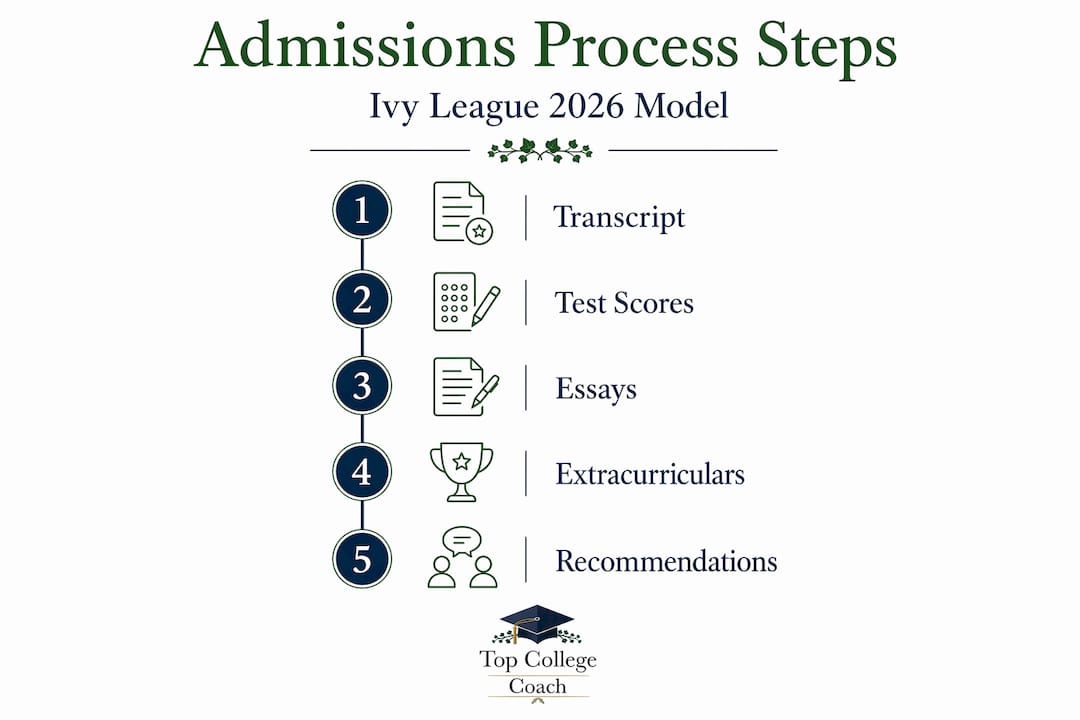
Breaking down the core application components
Academics: the foundation, not the finish line
Your transcript is the first thing an admissions officer reads, and it sets the tone for everything else. They are looking for the most rigorous curriculum available to you, whether that is AP, IB, or dual enrollment courses. A 4.0 in standard classes impresses no one at this level. A 3.8 in seven AP courses tells a story of ambition and follow-through.

Class rank still matters where schools report it, and grade trends carry real weight. A sophomore slump followed by a strong junior year is actually a compelling story of resilience if you address it somewhere in your application.
Essays: your clearest shot at being remembered
Admissions officers read thousands of essays about mission trips, sports injuries, and immigrant grandparents. That does not mean those topics are off-limits. It means execution must be extraordinary. Strong essays convey authenticity, emotional intelligence, and specific personal detail that no other applicant could replicate. Weak essays read as performed versions of what the student thinks an admissions officer wants to hear.
The best essays reveal intellectual curiosity in action. They show a student wrestling with a real question, not arriving neatly at a pre-packaged answer. That quality, more than polish, is what gets an essay passed around the admissions office.
Pro Tip: Before you write your main Common App essay, identify the one thing you want an admissions officer to know about you that does not appear anywhere else in your application. Start there.
Extracurriculars: depth, not decoration
Ivy League schools seek applicants with “spikes.” A spike is exceptional, meaningful depth in a single area rather than a long list of clubs you joined but never led. Examples include founding a startup, conducting independent scientific research, competing at a national level in athletics or music, or building a nonprofit with measurable community impact.
The student who has done ten activities at a surface level is far less interesting than the one who has gone deep on one or two things that genuinely matter to them. Authenticity is not just a buzzword here. It is what separates a memorable application from a forgettable one.
Recommendations: the voice that speaks for you
A generic letter that praises your “hard work and dedication” does almost nothing. Strong recommendation letters highlight specific moments: the time you pushed back on a teacher’s interpretation with a well-reasoned argument, the research paper you pursued beyond the assignment, the way you helped a classmate understand a concept. Specificity signals that a teacher truly knows you. That is the kind of reference that differentiates applicants who look identical on paper.
Choose recommenders who have watched you think, not just perform. A teacher who gave you an A but barely knows your name is the wrong choice, even if the class was impressive.
Understanding the Ivy League admissions timeline
Knowing when to apply is as strategic as knowing how. Here are the main rounds in order:
QuestBridge National College Match: Deadline in late September. This program serves high-achieving, lower-income students and can result in a binding match to a partner school, including several Ivies. It runs before all other application rounds.
Early Decision (ED) and Restrictive Early Action (REA): Deadlines typically November 1-2. Harvard and Yale use REA, which restricts you from applying early to other private schools. Brown, Columbia, Cornell, Dartmouth, and Penn offer binding ED. Brown’s ED acceptance rate of 14.58% compared to a sub-4% Regular Decision rate makes this a meaningful strategic lever.
Regular Decision (RD): Deadlines in January, with decisions released in late March on Ivy Day.
Ivy Day: All eight Ivy League schools release Regular Decision results on the same day in late March. The Class of 2030 admissions were finalized in March 2026. This coordinated release creates a single, high-stakes moment that students and families plan around for months.
Early Decision trade-offs at a glance
Factor | Early Decision | Regular Decision |
Acceptance rate | Significantly higher | Lower, most competitive |
Binding commitment | Yes, required | No |
Financial aid flexibility | Limited comparison shopping | Can compare all offers |
Best for | Students with a clear first choice and strong financial position | Students still weighing options or needing aid flexibility |
The financial aid trade-off is real. If you need to compare aid packages from multiple schools, binding ED may not be the right move regardless of the acceptance rate advantage.
Building a smart Ivy League application strategy
Here is where many families make costly errors. They treat the Ivy League as a single monolithic target and apply broadly, hoping something lands. That approach backfires.
Each Ivy has its own culture, priorities, and student body. Cornell values hands-on professional preparation. Brown prizes intellectual independence. Princeton emphasizes undergraduate research. Applying to all eight Ivies does not multiply your chances. It dilutes your effort and signals to each school that you did not care enough to understand them specifically.
A smarter college list looks like this:
2 to 3 Ivy or Ivy-equivalent reaches that genuinely fit your academic and personal profile
2 to 3 strong target schools where your credentials fall within the middle 50% range
2 safety schools where you would genuinely be happy attending and where admission is near-certain
Pro Tip: Research the “Why Us” essay requirements early. Schools that ask this question are explicitly testing whether you have done your homework. Generic answers get flagged immediately. Specific program names, faculty research, and campus traditions show real engagement.
When it comes to building the application itself, treat your essays, extracurricular descriptions, and recommendations as chapters of one coherent story. Applicants who tie together their academic interests, passions, and leadership around a clear theme give admissions officers a vivid mental image of who they are and what they will contribute on campus. That coherence is what the Ivy League college selection process ultimately rewards.
Summer is also strategic. Meaningful research programs, internships, or independent projects in the year before applications open can become the anchor of your extracurricular narrative. Investing that time well before senior year pays dividends across every part of your file.
My honest take on what families get wrong
I have worked with hundreds of students through this process, and the most heartbreaking cases are the ones who had genuinely impressive profiles but undermined themselves with over-optimization. They chased activities they thought looked good instead of pursuing things they actually cared about. The resulting essays felt hollow. The recommendations were polished but impersonal. And admissions officers, who read thousands of files, can feel that inauthenticity immediately.
What I have learned is that Ivy League admissions have evolved into talent scouting. These schools are building a class of future leaders and innovators, not just rewarding past performance. A student who built something real, wrote about it honestly, and can articulate where they want to go next is more compelling than a student who did everything “right” but cannot tell you why.
My other strong conviction: do not treat a rejection from an Ivy as a verdict on your worth or your future. I have seen students thrive at schools that were not their first choice and go on to careers that exceeded every expectation. The goal is finding the right fit, not winning a prestige contest. Start the process with that mindset and you will make better decisions at every stage.
— Randy Pryor, Founder - Top College Coach
How Top College Coach can help you get there
The complexity of the Ivy League admissions process is real, and navigating it alone puts students at a disadvantage in one of the most competitive pools in the world.
At Top College Coach, we work directly with students and families to build application strategies grounded in data, personal story, and genuine fit. Our counselors guide you through essay development, school list construction, recommendation management, and interview preparation, drawing on a proven track record of admissions success at Ivy League and Top 20 universities. We serve families from our Orlando, Florida base and virtually across the country, with five-star reviews from students who got in. If you are ready to move from anxious to prepared, schedule your free strategy session and let us show you what a focused, personalized approach can do.
FAQ
What do Ivy League schools actually look for?
Ivy League schools use holistic admissions review, weighting curriculum rigor, essays, extracurricular depth, recommendations, and character alongside test scores. No single factor decides admission.
Is Early Decision worth it for Ivy League schools?
Early Decision acceptance rates are meaningfully higher at schools like Brown, where ED rates reach 14.58% versus under 4% for Regular Decision. The trade-off is a binding commitment that limits financial aid comparison.
Do all Ivy League schools require SAT or ACT scores?
For Fall 2026, six of eight Ivy League schools require standardized testing. Columbia is test-optional, and Princeton remains test-optional through the 2026-27 cycle.
Should I apply to all eight Ivy League schools?
Applying to all eight Ivies does not improve your chances. Each school values specific criteria and profiles, and scattershot applications signal a lack of genuine interest to admissions officers.
How important are essays compared to test scores?
Essays matter to 85% of selective schools while SAT/ACT scores matter to only 36%, according to Common Data Set analysis. A compelling, authentic essay carries significantly more weight than a marginal score improvement.
Recommended
Comments