How to Write Scholarship Application Essays That Win

Writing scholarship application essays is the single most controllable factor in your college funding strategy. Your GPA is fixed, your test scores are history, but your essay is a blank page you own completely. Scholarship committees read hundreds of applications, and the students who win are rarely the ones with the most impressive resumes. They are the ones who tell the most honest, specific, and purposeful stories. This guide walks you through exactly how to do that, from preparation through final revision, so you can apply with confidence and compete for real money.
How to write scholarship application essays that stand out
The first thing to understand is that scholarship essays are not academic papers. They are personal narratives with a strategic purpose. The goal is to show a committee who you are, why you align with their mission, and why investing in you makes sense. Most scholarship essays fall between 500 and 1,000 words, which means every sentence carries weight. Short essays demand precision. Each sentence must prove something meaningful about you as a writer and as a person.
Scholarship committees are not looking for perfection. They are looking for authenticity. Committees prefer small, specific moments over grand achievements because relatable, honest writing connects with readers in a way that a list of awards never can. The student who writes about teaching her grandmother to use a smartphone reveals more character than the one who lists three varsity sports. Specificity is your competitive advantage.

Tailoring your essay to each sponsor is not optional. Generic essays are a top rejection reason, and committees can spot a recycled essay within the first three sentences. Tailoring each essay to the sponsor’s mission improves scholarship win rates by approximately 60%. That number reflects a simple truth: committees want to fund students who understand and share their values.
What to do before you write a single word
Preparation separates students who scramble at the deadline from those who write with clarity and purpose. Before you open a blank document, complete these steps.
Research the sponsor’s mission. Read the scholarship organization’s website, their past recipients’ profiles, and any stated values. Your essay should reflect their language and priorities back to them in your own authentic voice.
Gather your documents early. Collect your transcript, any FAFSA information, and a list of your activities, honors, and work experience. Having these in one place prevents last-minute panic.
Build a scholarship tracker. A simple spreadsheet with columns for scholarship name, deadline, word count, required documents, and submission status keeps you organized across multiple applications.
Read the instructions carefully. Word limits, font requirements, and specific prompt language all matter. Submitting a 900-word essay to a 500-word prompt signals carelessness.
Use writing tools wisely. Grammarly is useful for catching grammar errors and improving sentence clarity. AI writing tools can help you brainstorm, but your essay must sound like you, not a machine.
Pro Tip: Give your recommendation letter writers a “brag sheet” with your key accomplishments, goals, and the specific scholarship you are applying for. Providing recommenders context and at least two weeks’ notice produces significantly stronger, more personalized letters.
A step-by-step process for writing a compelling essay
Once you are prepared, the writing itself becomes far less intimidating. Follow this framework to move from blank page to polished draft.
Answer the prompt directly. Read the prompt three times before writing. Underline the core question. Every paragraph you write should connect back to that question. Drifting off-topic is one of the most common ways students lose readers.
Use the Moment-Meaning-Future structure. The Moment-Meaning-Future framework is one of the most effective ways to organize a scholarship essay. Start with a specific moment from your life, explain what it meant to you, and connect it to where you are headed. This structure answers the three questions every reviewer asks: Who are you? Can I believe you? Should we invest in you?
Open in the middle of the action. Do not begin with “I was born in…” or “Since I was young, I always wanted to…” Drop the reader into a specific scene. “The fluorescent lights of the hospital waiting room hummed above me as I translated my mother’s diagnosis to her in Spanish” is a hook. “I have always been passionate about medicine” is not.
Show, do not tell. Scholarship essays should show with specific scenes and evidence rather than tell with adjectives. “I am a dedicated leader” tells the reader nothing. “I reorganized our school’s food drive after turnout dropped 40%, and we collected twice as many donations the following year” shows it.
Write in plain, clear language. Scholarship judges are not experts in your field. Write for a smart adult who knows nothing about your specific experience. Jargon, acronyms, and technical language create distance instead of connection.
Connect your story to your future. The final paragraph should tie your past experience to your goals and explain why this scholarship specifically supports that trajectory. Make the committee feel like funding you is an obvious decision.
Pro Tip: If you feel stuck, record yourself speaking your answer to the prompt out loud and then transcribe it. Oral storytelling produces natural voice and often breaks through writer’s block faster than staring at a screen.
Common mistakes that cost students scholarship money
Revision is where scholarship money is made or lost. Most students treat their first draft as nearly final. The students who win treat it as raw material.
“Revision is the stage where scholarship money is made. Do not fear extensive rewriting and theme changes.” — Kristina Ellis, scholarship expert and author
Here are the most common mistakes to fix during revision:
Generic openings. If your first paragraph could belong to any student, rewrite it. Reviewers read hundreds of essays and a strong hook in the first paragraph is the only way to guarantee your essay gets a fair read.
Starting too many sentences with “I.” Vary your sentence structure. Leading every sentence with “I” makes your essay feel flat and self-absorbed, even when the content is strong.
Keeping paragraphs that do not serve the core message. Cutting strong but off-theme content is one of the hardest and most important revision skills. If a paragraph is well-written but does not connect to the prompt or your central theme, remove it.
Overused closing phrases. “In conclusion,” “Finally,” and “In summary” signal a weak ending. Close with a forward-looking sentence that reinforces your purpose and leaves a lasting impression.
Skipping the read-aloud test. Reading your essay aloud catches awkward phrasing, run-on sentences, and unnatural transitions that your eyes skip over when reading silently.
Seek feedback from a trusted teacher, school counselor, or admissions advisor. Fresh eyes catch what you cannot. At Top College Coach, we see students transform good essays into great ones through two or three focused revision sessions. You can also review how colleges evaluate application essays to understand what reviewers are actually looking for.
How to reuse essay content across multiple applications
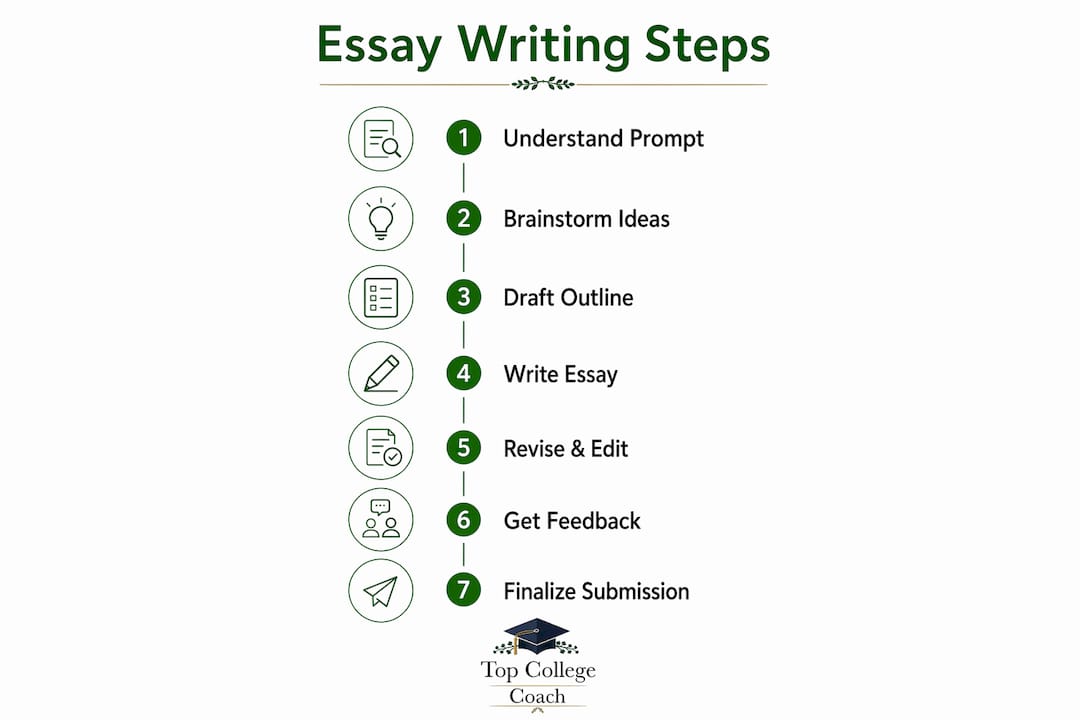
Applying to 10 to 15 scholarships per cycle is the recommended volume for most students. High-volume applicants sometimes submit 30 or more annually. Writing a completely original essay for each one is neither realistic nor necessary. The key is smart customization, not wholesale copying.
Approach | What it means in practice |
Master essay | Write one strong core essay that captures your central story and values |
Customized introduction | Rewrite the opening paragraph to reference the specific scholarship’s mission |
Adjusted examples | Swap out one or two supporting examples to align with each sponsor’s focus |
Tailored conclusion | Revise the final paragraph to connect your goals directly to that scholarship |
Verbatim copying | Never submit the same essay unchanged to two different scholarships |
Keep your master essay in a document and create a new copy for each application. Track which version you sent where in your scholarship spreadsheet. This system lets you apply to more scholarships without sacrificing the quality that wins them. Students who want to explore athletic funding options can also review guidance on athletic scholarship preparation as part of their broader strategy.
Key takeaways
Winning scholarship essays combine authentic storytelling, precise tailoring to each sponsor’s mission, and disciplined revision across multiple drafts.
Point | Details |
Tailor every essay | Generic essays are a top rejection reason; customization improves win rates by approximately 60%. |
Use Moment-Meaning-Future | This structure answers the three core reviewer questions and avoids generic biography writing. |
Show with specifics | Replace adjectives with scenes, numbers, and outcomes to prove your claims. |
Revise extensively | Multiple drafts are standard; cutting off-theme content strengthens the final essay. |
Apply to 10-15 scholarships | Use a master essay with targeted customizations to maintain quality at volume. |
What I have learned from watching students win and lose scholarships
I have worked with hundreds of students through the scholarship application process, and the pattern is consistent. The students who win are almost never the ones with the most impressive credentials. They are the ones who are willing to be honest on the page.
The most common mistake I see is students writing the essay they think the committee wants to read. They reach for big, dramatic moments: the mission trip, the championship game, the family tragedy. Those stories can work, but only when they are told with genuine reflection. What actually resonates is the student who writes about something small and specific and then connects it to a larger truth about who they are. Authenticity is not a writing style. It is a decision to stop performing and start communicating.
I also want to say something about rejection. You will not win every scholarship you apply for. That is not a reflection of your worth or your writing. Scholarship decisions involve factors you cannot control, including committee priorities, applicant pool size, and funding constraints. What you can control is the quality of your essay and the number of applications you submit. Both of those are entirely within your reach.
The revision process is not punishment. It is the work. Every draft you write teaches you something about your own story. By the time you submit your final version, you should know exactly why you deserve that scholarship. That clarity comes through in the writing, and committees feel it.
— Randy Pryor, Founder - Top College Coach
Work with Top College Coach to strengthen your scholarship essays
At Top College Coach, we have helped students gain admission to Ivy League and Top 20 universities, and that same strategic approach applies directly to scholarship applications. Our counselors provide personalized essay review sessions that go beyond grammar corrections. We help you identify your most compelling story, align it with each scholarship’s mission, and revise it until it is genuinely competitive. If you are serious about funding your college education, the earlier you start working with an expert, the more opportunities you can pursue. Book a consultation with Top College Coach today and give your scholarship essays the attention they deserve.
FAQ
How long should a scholarship essay be?
Most scholarship essays are between 500 and 1,000 words. Always follow the specific word limit in the application instructions, since exceeding it signals you cannot follow directions.
What are the most common scholarship essay prompts?
Common prompts ask about your career goals, a challenge you have overcome, a person who influenced you, or your community involvement. The Moment-Meaning-Future structure works well across all of these formats.
How do I make my scholarship essay stand out?
Open with a specific scene rather than a broad statement, use concrete details instead of adjectives, and connect your story directly to the scholarship sponsor’s stated mission. Committees can identify authentic, specific writing within the first paragraph.
Can I reuse the same essay for multiple scholarships?
You can reuse a core essay as a starting point, but you must customize the introduction, conclusion, and key examples for each scholarship. Submitting identical essays to different sponsors is one of the fastest ways to get rejected.
How many scholarships should I apply for?
Applying to 10 to 15 scholarships per cycle is the recommended starting point. Students who apply to more scholarships with well-tailored essays consistently secure more funding than those who apply to fewer with generic submissions.
Recommended
Comments