Ivy League Acceptance Rates: What You Need to Know

If you’ve been researching the acceptance rate Ivy League schools post each spring, you already know the numbers are brutal. Yale admitted just 2.9% of applicants in its most recent cycle. Columbia accepted 4.23% from a pool of over 61,000 students. These figures shock most families, but the real problem isn’t the numbers themselves. It’s what students and parents do with them. At Top College Coach, we’ve worked with hundreds of families who started their college search paralyzed by statistics and finished it with acceptance letters from schools they love. This guide gives you the full picture.
Table of Contents
Key takeaways
Point | Details |
Acceptance rates are at record lows | Yale, Harvard, and Columbia all posted historic lows in 2026, making strategic preparation more critical than ever. |
Holistic review goes far beyond grades | Authenticity, intellectual curiosity, and demonstrated impact carry more weight than a perfect GPA alone. |
Policy changes reshaped the pool | The 2023 SFFA Supreme Court ruling shifted demographic enrollment patterns across all eight Ivy League schools. |
A balanced list protects your future | Applying only to Ivies is high risk; experts recommend a mix of reach, target, and safety schools. |
Expert guidance produces real results | Roughly one in five Ivy League freshmen used an independent admissions consultant during their application process. |
Acceptance rate Ivy League schools report in 2026
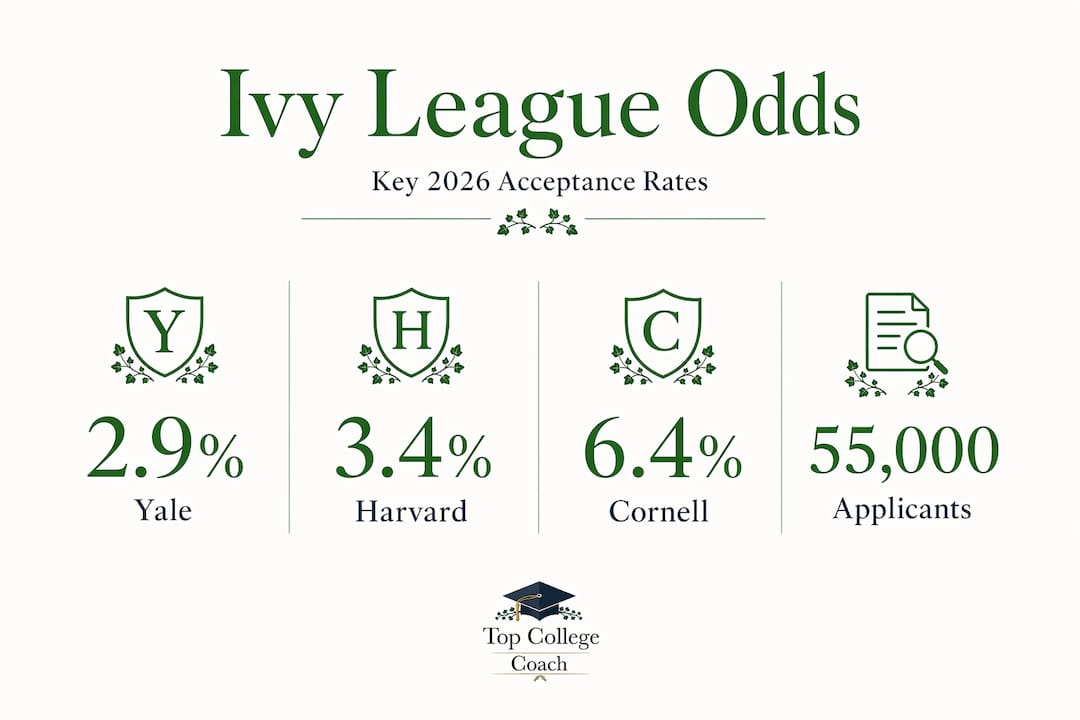
The numbers this year are not just low. They are historically low. Yale accepted 2.9% of its 55,000 applicants. Harvard sits at approximately 3.7%. Brown came in at 5.35%, and Dartmouth landed around 6%. These ivy league acceptance ratios reflect years of applicant pool growth colliding with class sizes that have not expanded proportionally.

Here is a snapshot of where each school stands:
School | Approximate Acceptance Rate | Approximate Applicants |
Yale | 2.9% | 55,000 |
Harvard | 3.7% | 54,000+ |
Columbia | 4.23% | 61,031 |
University of Pennsylvania | 5.4% | 59,000+ |
Brown | 5.35% | 51,000+ |
Dartmouth | 6.0% | 28,000+ |
Princeton | ~3.9% | 40,000+ |
Cornell | ~7.6% | 67,000+ |
Twenty years ago, several of these schools admitted 15% or more of their applicants. Today, even Cornell, the most accessible of the eight, sits well under 10%. This downward ivy league acceptance trend reflects both surging application volumes and the Common App’s role in making it easier to apply to a dozen schools in an afternoon.
What this data tells you strategically is that even extraordinary students face long odds at any single school. This is not a reason to abandon Ivy ambitions. It is a reason to plan with eyes wide open.
How the SFFA ruling changed Ivy admissions
In June 2023, the Supreme Court’s Students for Fair Admissions decision effectively ended race-conscious admissions at American universities. The downstream effects on ivy league admission statistics became visible quickly. Black freshman enrollment across Ivy League schools dropped from 11% to 8% of incoming classes. Hispanic representation fell from 16% to 15%, while white and Asian shares each ticked upward.
These shifts matter for your strategy in several concrete ways:
Legacy and donor preferences are facing increased scrutiny and several schools are reducing their weight, which changes the competitive calculus for all applicants.
Socioeconomic diversity has emerged as a new focal point, with schools expanding financial aid and actively recruiting first-generation students to compensate for demographic losses.
Geographic diversity is now more explicitly valued, meaning students from underrepresented states or regions carry a real edge.
Personal identity essays have changed in nature. Schools still want to understand who you are, but they must rely on non-racial factors to assess diversity of perspective and experience.
Pro Tip: Track each school’s stated commitment to socioeconomic and geographic diversity when crafting your application. If you are from a rural state, a mid-sized city, or a first-generation college background, weave that context meaningfully into your essays and activities list.
The institutional responses to SFFA are still evolving. Some schools have restructured their admissions offices, others have launched new recruitment pipelines in underserved communities. Following these updates on individual school websites each fall gives you an edge most applicants never bother to pursue.
What Ivy League schools actually look for
Here is what most families get wrong: they believe a 4.0 GPA and a 1580 SAT score makes someone a competitive Ivy applicant. Those numbers might get your application read. They will not get you in on their own.
The ivy league admissions process is genuinely holistic, and that word means something specific. Admissions readers evaluate your entire file as a puzzle. Your academic record, your activities, your essays, your recommendations, and your demonstrated intellectual life all have to tell a coherent story about who you are and what you will contribute to that campus community.
Here is how to think about the key dimensions:
Academic rigor first. The hardest schedule you can handle at your school matters more than the grade at the end of it. Admissions readers know what AP, IB, and dual enrollment options exist at your high school. They notice if you avoided the hard path.
A genuine “spike.” Ivy schools are not looking for well-rounded students as much as they are looking for students with a distinct area of depth. A student who has published original research in biology, performed at Carnegie Hall, or built a sustainable micro-business stands out far more than a student with twelve average activities.
Essays that sound like you. Admissions officers are trained to spot inauthentic or AI-generated writing. The students who earn admission write essays that only they could have written, stories grounded in specific memories, relationships, and growth that no algorithm can replicate. Read our guide on AI risks in applications before you touch any AI writing tool.
Recommendations that go beyond “excellent student.” A great letter of recommendation gives concrete anecdotes. It says “she rewrote her lab report three times until the data was airtight,” not “she is a dedicated learner.”
Demonstrated interest and fit. Some Ivies track demonstrated interest more than others, but every school wants applicants who can articulate specifically why that school matches their intellectual and personal goals.
Pro Tip: Before writing a single essay, build what we call an “activity narrative.” Write one sentence about the thread connecting your most meaningful experiences. If you cannot identify that thread clearly, admissions readers will not be able to either.
Experts consistently emphasize that demystifying this holistic process is the single most valuable thing a student or family can do early in the college search. Understanding what readers are actually looking for changes how you spend your junior and senior years, not just how you fill out the application.
Building a smart, balanced college list
Given the ivy league acceptance rates explained above, applying to eight schools that each admit fewer than 8% of applicants is not a strategy. It is a gamble. Experts widely advise building a list that includes reach, target, and safety schools so that your outcome is not binary.
A practical balanced list for an Ivy-level student might look like this:
Category | Examples | Why They Belong |
Reach | Harvard, Yale, Columbia | Dream schools; apply with full effort and zero expectation |
High Reach | Duke, Georgetown, Vanderbilt | Highly selective but slightly higher admit rates |
Target | Tulane, Wake Forest, Case Western | Academically strong fits where your profile is genuinely competitive |
Safety | University of Florida, Indiana University Kelley | Excellent programs where admission is near-certain |
Notice that “safety” does not mean “bad school.” It means a school where you would genuinely thrive if your reach schools do not work out.
A few principles worth following as you build your list:
Apply early decision or early action strategically. ED acceptance rates at many Ivies and near-Ivy schools run two to three times higher than regular decision rates.
Research each school’s net price calculator early. Financial fit matters as much as academic fit, especially if your family will be paying full price.
Visit or attend virtual information sessions. Cornell’s admissions profile and similar resources can help you understand exactly what a given school values before you commit application resources to it.
Students are increasingly recognizing the lottery-like nature of Ivy admissions and shifting toward diversified application approaches. That pragmatism is not defeat. It is wisdom.
Making the most of admissions consulting
About 20% of Ivy League admits worked with an independent admissions consultant. That number has risen steadily as the process has grown more competitive. But not all consultants are equal, and the wrong guidance can actually hurt your application.
Here is how to evaluate any consulting relationship:
Look for transparency, not guarantees. Any consultant who promises Ivy admission is misleading you. The honest ones give you strategy, not certainty.
Prioritize experience over prestige. A counselor who has worked with dozens of successful Ivy applicants understands patterns that a brand-new consultant simply cannot see yet.
Watch for over-coaching. If a consultant is rewriting your essays for you, that is a red flag. Admissions officers recognize voices that do not match the rest of the file. Learn more about finding Ivy admissions support that amplifies your voice rather than replacing it.
Ask about their process. Strong consultants start with who you are, not what schools want. They build your application from the inside out.
Pro Tip: Use your consultant to stress-test your activity narrative and essay drafts, not to write them. The application that gets you in is the one that sounds like you on your best day, not a professional writer’s version of you.
The cost of quality consulting is real. So is the cost of a misguided application to fifteen schools. When you weigh the investment against the outcome, personalized guidance from someone who genuinely knows the ivy league admissions process is often the highest-leverage decision a family can make.
My honest take after years in this work
I have watched thousands of applications go through this process, and I want to share something that the data alone cannot tell you.
Ivy admissions has always had a lottery element. Even the most compelling applicant, one with original research, a beautiful essay, and glowing recommendations, can be denied when Harvard’s engineering slots fill up before her file gets a thorough read. That randomness is real. Pretending otherwise does families a disservice.
What I have also seen, consistently, is that students who approach the process with genuine curiosity rather than credential-chasing tend to build stronger applications. They write essays that breathe. Their activities reflect real passion. Their recommendations say something specific. They come across as people, not profiles.
The SFFA ruling and the rise of AI-generated content have made authentic voices more valuable, not less. And Harvard’s grade cap initiative, where faculty voted to limit A grades to 20% per course starting fall 2027, signals something important: rigorous academic challenge is being recalibrated industry-wide. Schools are watching whether students choose difficult paths, not just whether they earned A’s on easy ones.
My advice is this. Respect the numbers. Do not be consumed by them. Build the best version of your application and your list. Then trust the process to work, especially when you’ve done the preparation well.
— Randy Pryor, Founder - Top College Coach
Let Top College Coach guide your Ivy League strategy
At Top College Coach, we specialize in exactly this. Helping students and families decode the ivy league admissions process, build applications that reflect genuine strength, and create balanced lists that protect against the unpredictability of elite admissions. Our counselors bring real experience, not generic templates.
Whether you are a sophomore starting to think about your profile, or a senior finalizing your college list, we offer personalized admissions counseling built around your specific goals and story. Our five-star track record speaks for itself, but we would rather show you what’s possible in a conversation. Schedule your free strategy session today and let’s map out your path to the school you deserve.
FAQ
What is the lowest acceptance rate in the Ivy League?
Yale currently holds the lowest acceptance rate among Ivy League schools at approximately 2.9%, based on the most recent admissions cycle with over 55,000 applicants.
Do Ivy League acceptance rates keep dropping every year?
The general trend over the past two decades has been downward, though individual schools fluctuate slightly year to year as applicant pool sizes and institutional priorities shift.
How does the SFFA ruling affect Ivy League admissions today?
The 2023 Supreme Court decision ended race-conscious admissions, leading to measurable drops in Black and Hispanic freshman enrollment across Ivy League schools while white and Asian shares increased.
Does using an admissions consultant improve my chances?
Roughly one in five Ivy League freshmen used an independent consultant, though outcomes depend entirely on the quality of guidance and whether it enhances your authentic voice rather than replacing it.
What GPA and test scores do I need for Ivy League admission?
Strong academic credentials are necessary but not sufficient. Ivy League schools use holistic review, and intellectual curiosity, depth of extracurricular involvement, and authentic storytelling carry substantial weight alongside grades and scores.
Recommended
Comments