Parents: 10 Ivy League Admission Myths and What To Do Instead
Updated: Sep 14

No single myth decides an Ivy League outcome. Not perfect test scores, not legacy status, not one dazzling extracurricular. What actually moves admissions officers is consistency, academic rigor, and a coherent story about who a student is and what they’ve built over four years. The myths below explain why so many families chase the wrong targets, and what to focus on instead.
TL;DR:
Strong course rigor and consistent upward academic trends are more important than perfect test scores or a flawless GPA.
Extracurricular depth and coherence across academics, activities, and essays outweigh the number of pursuits or global scale.
Application timing strategies like Early Decision require careful consideration of financial aid trade-offs and are not guaranteed to improve chances.
Race and legacy policies are complex but do not guarantee admission; holistic review remains central, and personal storytelling still matters.
Recommendation letters with specific anecdotes hold more weight than generic praise, and demonstrated genuine interest through tailored essays is more effective than sheer volume of contacts.
Table of Contents
Common Ivy League Admission Myths, Debunked
Most Ivy League admission myths survive because they contain a grain of truth stretched past its breaking point. Here’s what actually happens behind the file, myth by myth.
A perfect GPA guarantees a spot. Reality: admissions readers and officers care more about the difficulty of your course load than a flawless transcript. All A's will not benefit you greatly if all of your classes are easy. Takeaway: choose the harder class, even if it costs you a fraction of a grade point.
One B will ruin your chances. Reality: readers look for patterns across four years, not a single lower grade. A B in organic chemistry junior year, surrounded by an upward trend, rarely registers as a problem. Each year, we help students with multiple B's gain admission to Ivy League schools. Takeaway: context, course difficulty, and trajectory matter more than any single grade.
Every AP class automatically helps. Reality: piling on APs you are unable to handle will signal poor judgment, not ambition. Before you start stacking 6-7 APs, make sure you can maintain your grades with the increased workload. Takeaway: take the APs that align with your interests and that you can genuinely do well in.
A 1600 SAT guarantees admission. Reality: once scores cross a certain threshold, marginal increases stop differentiating applicants, and rigor and consistency carry more weight than the last 50 points. Review the CDS of your target schools, and aim for the 50th percentile. Takeaway: stop chasing a perfect score once you’re already competitive.
Only wealthy or legacy students get in. Reality: test-optional policies and generous financial aid have widened the applicant pool considerably at top colleges, and affordability now shapes decisions as much as connections do. Private schools often provide greater affordability than out-of-state public schools. Takeaway: don’t rule out a school before checking its aid packages.
Applying Early Decision always helps your odds. Reality: ED can boost acceptance likelihood, but it is binding and locks you into one financial aid offer before you can compare others. Pre-planning, research, and frank discussions with family members are the key to ED. Takeaway: run the numbers on affordability before committing early.
Varsity Blues proves the whole system is rigged. Reality: those scandals were exceptional fraud cases, organized by one bad actor. It was not evidence that routine holistic review is broadly corrupt. Takeaway: do not let a headline scandal convince you the process is unwinnable through legitimate effort.
Extracurriculars need to be globally scaled to count. Reality: massive, unsustainable-looking projects can raise skepticism rather than admiration if they seem disconnected from a student’s real life. Beyond that, many schools realize that these projects duplicate the efforts of others, and will cease to exist after the student leaves high school. Takeaway: depth in one or two activities beats a resume padded with symbolic titles.
You have to be a certified genius. Reality: admissions offices are assembling a class, not crowning prodigies, and they weigh institutional needs alongside academic merit. While some schools look for specific spike, others seek well-rounded students to join their community. Takeaway: authentic engagement outperforms manufactured brilliance.
Test-optional means test scores don’t matter at all. Reality: submitting a strong score can still strengthen an application. Test-optional simply removes the requirement, but you may still have a significant benefit from a good score. Takeaway: submit scores if they help your case, skip them if they don’t.
Pro Tip: Before assuming a myth applies to your situation, ask “What would an admissions reader actually see in this?” That single question deflates most of these misconceptions instantly.
How Admissions Timelines and File Reviews Shape These Myths
Many myths trace back to structural realities most families never see. Understanding the mechanics behind Early Decision, financial aid, and file review explains why some strategies work and others backfire.
Early Decision is binding: commit, get in, and you’re withdrawing every other application. Early Action is nonbinding, letting you apply early without forfeiting the right to compare offers later. The trade-off is real. ED can raise your odds at some schools, but it also removes your ability to weigh financial aid packages side by side, a serious problem if your family’s costs vary significantly across offers.
“Need-blind” admissions mean your ability to pay isn’t factored into the admit decision itself, though it can still shape financial aid outcomes at need-aware institutions. “Meets full demonstrated need” sounds generous, but the calculation of that need varies school to school, so two need-blind Ivies can produce very different aid letters for the same family.
File review itself runs faster and more structurally than most applicants imagine:
Readers are often assigned by region, so they understand local grading scales and curricula before judging your transcript.
Borderline files typically move to committee review rather than getting decided by one person.
Clarity and organization in your application help a reader who is moving quickly through a stack of files.
Applying Early Action or Early Decision only makes sense once you understand these mechanics, not before.
What Actually Differentiates Successful Applicants
Course rigor beats an inflated GPA every time a reader compares two transcripts. A 3.8 in the hardest available classes usually reads stronger than a 4.0 padded with easy electives.
Consistency and upward trajectory matter more than any single semester. Readers want to see a student who grew, not one who peaked freshman year and coasted.
Coherence ties it together: when your academic interests, extracurriculars, and essays point in a related direction, the application reads as a real person rather than a checklist. Big awards help when they fit that story. They raise flags when they look like the only thing you did, suggesting an unsustainable or lopsided commitment.
They’re scanning for patterns across four years, not searching for a single perfect data point.
What Top College Coach Recommends Right Now
Start with prioritization. Pick the hardest courses you can genuinely handle, the tests worth submitting, and two or three extracurriculars where you can show real depth instead of ten shallow ones.
Choose classes and tests that reflect actual strength, not just prestige.
Decide Early Decision versus Regular Decision based on certainty and affordability, not just acceptance-rate math.
Use essays and recommendation letters to reinforce one coherent story, not to check boxes.
Pro Tip: Ask your recommenders to highlight a specific moment of growth, not a generic list of your best qualities. Specificity is what makes a letter memorable.
Review what admissions officers actually want to see before finalizing your list of target schools.
Misconceptions About Race and Affirmative Action Policies
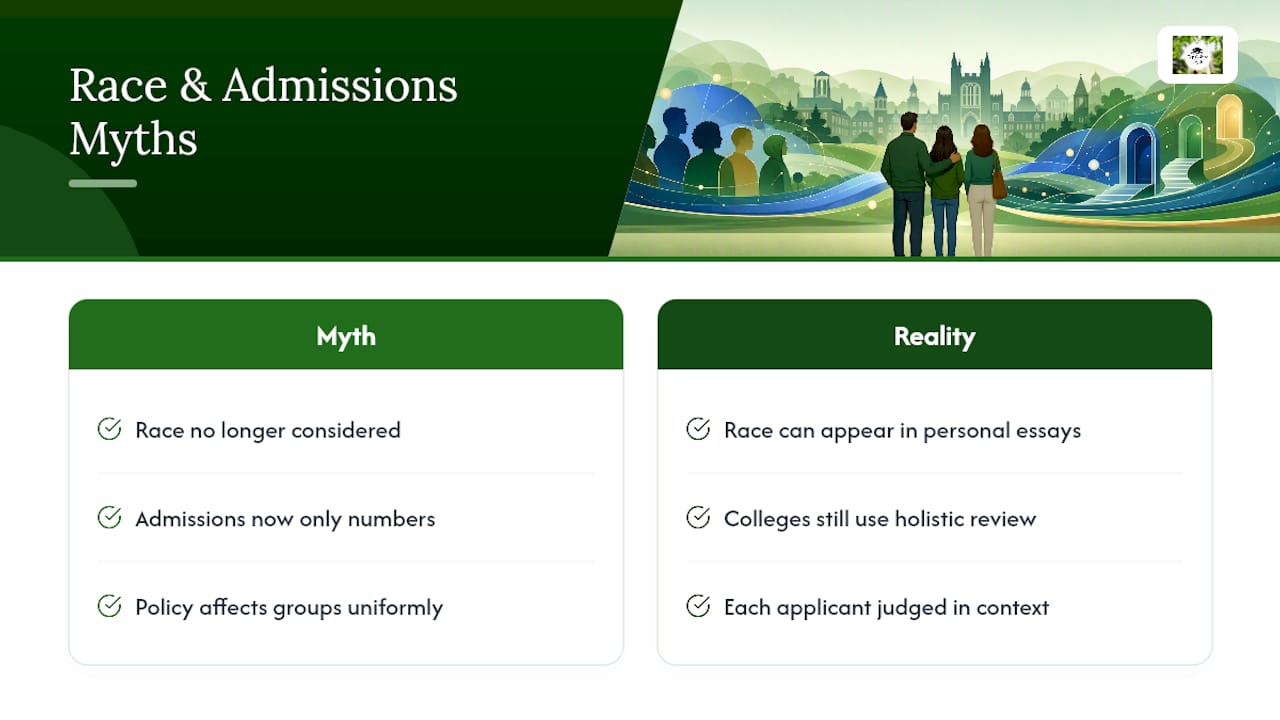
Confusion around affirmative action has only deepened since the Supreme Court’s 2023 ruling limiting race-conscious admissions, and a lot of families now assume the opposite extreme: that race can no longer factor into an application at all. That’s not accurate. Students can still discuss their racial or ethnic background as part of a personal narrative, an essay about identity, or an account of a formative experience, since the ruling restricted institutional use of race as a categorical admissions factor, not personal storytelling.
Another myth holds that removing race-conscious policies made admissions purely numbers-driven. It didn’t. Colleges still practice holistic review, weighing rigor, character, and context alongside test scores and grades. What changed is how universities collect and apply demographic information at the institutional level, not whether a student’s lived experience can appear in their application.
Families sometimes assume this shift helps or hurts specific groups uniformly. It doesn’t work that way. Every applicant is still evaluated as an individual file, shaped by their own coursework, community, and opportunities. The policy change altered the mechanics of institutional decision making. It didn’t turn admissions into a formula, and it didn’t eliminate the value of telling your own story honestly.
The Role and Influence of Recommendation Letters
A lukewarm recommendation letter can undercut an otherwise strong application faster than almost anything else in the file. Readers know the difference between a teacher who writes ten generic letters a year and one who takes the time to describe a specific, memorable moment of a student’s growth or character.
The myth here is that recommendation letters are a formality, something to collect and move past. In practice, they often provide the only outside, unfiltered perspective in the entire application. Your grades and essays come from you. A recommendation letter comes from someone who watched you struggle, improve, and contribute in a classroom or activity over real time.
That’s why generic praise (“hardworking,” “a pleasure to have in class”) rarely helps, while a specific anecdote, a moment where a student pushed through a tough problem set or spoke up for a classmate, tends to stick with readers. Choosing the right recommender matters more than choosing the most famous or highest-ranking one. A teacher who knows you well will always outperform a department head who barely remembers your name.
How Demonstrated Interest Affects Admission Chances
Demonstrated interest, the signals a school tracks showing how engaged you are with them specifically, does factor into decisions at many colleges, though its weight varies widely by institution. Highly selective private universities track it inconsistently, and several elite institutions state outright that they don’t consider it at all.
The myth that emailing an admissions officer repeatedly or attending every info session guarantees a bump in your favor is mostly wrong. What tends to matter more is a genuinely specific supplemental essay that shows you understand a particular program, professor, or opportunity at that school, not a generic essay swapped between ten applications with the school’s name changed.
Visiting campus, attending a virtual info session, or connecting with a current student can sharpen your own understanding of fit, which then shows up naturally in your essays. That’s a more reliable path than treating demonstrated interest as a box to check through sheer volume of contact.
Common Myths About Legacy and Donor Influence
Legacy status is not the guaranteed backdoor many families imagine, and its influence has been shrinking as several Ivy League institutions have scaled back or eliminated legacy preference entirely in recent admissions cycles. Where it still exists, it typically functions as a modest tiebreaker among already-qualified candidates, not a substitute for a competitive academic record.
Donor influence carries a similar myth. Large-scale development cases, where a major gift directly correlates with an admission decision, are rare and typically reserved for exceptional, institution-level giving far beyond what most families ever encounter. Assuming that a modest donation or an alumni parent guarantees favorable treatment misreads how rare and specific that influence actually is.
Admissions policy exists to assemble a class that meets institutional goals, including diversity, departmental needs, and yes, some legacy and development considerations. But that’s a small piece of a much larger puzzle built primarily around academic strength and fit, not a hidden shortcut available to anyone with a familiar last name.
Myth: Elite Prep Schools Guarantee Admission
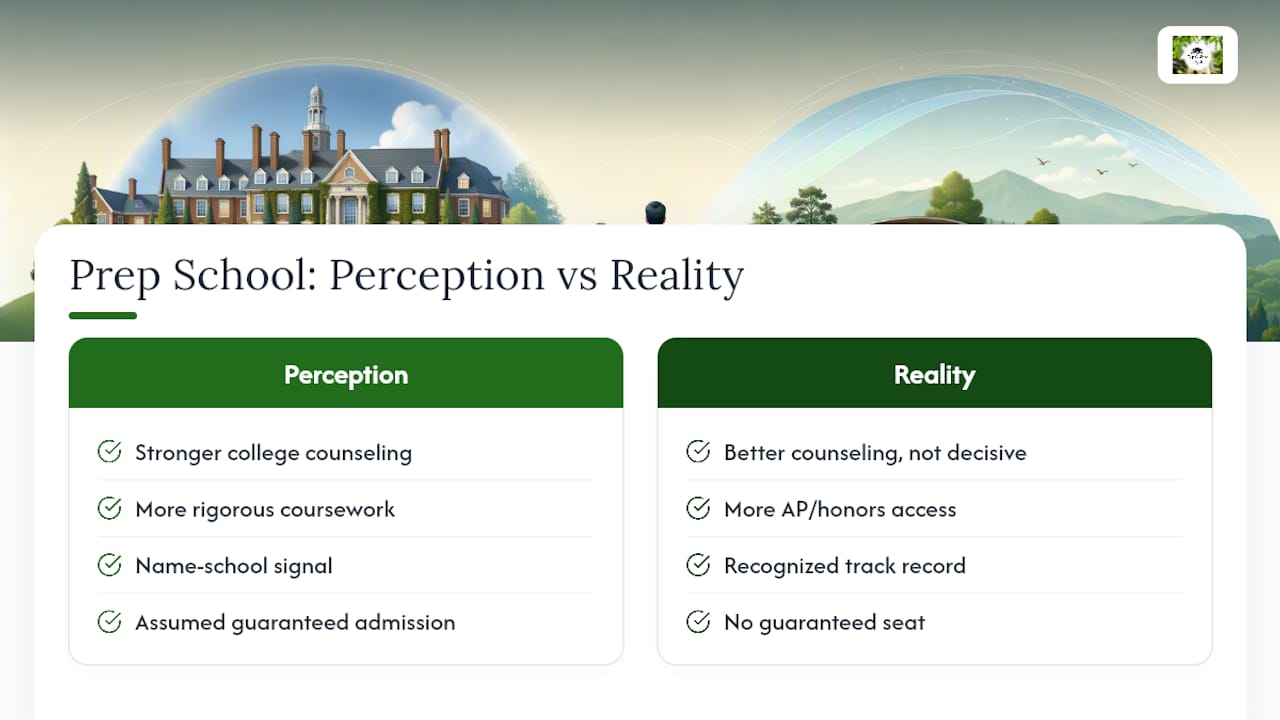
A prestigious prep school can offer stronger college counseling, more rigorous coursework, and a track record admissions offices recognize. None of that guarantees a single seat. Students from elite prep schools get rejected from Ivy League universities every year, often because rigor and grades alone don’t distinguish them from dozens of similarly credentialed classmates at the same school.
The real advantage prep schools offer is infrastructure: better access to AP and honors courses, dedicated counselors who understand the process, and peers pushing each other academically. That infrastructure helps a student build a stronger file. It doesn’t replace the need for a coherent, authentic application. Readers evaluate students against their own school’s context and opposition, meaning a standout student from an under-resourced public school can compete directly with a middling student from a name-brand prep school.
Public school students, homeschoolers, and international applicants get into Ivy League schools every cycle without ever setting foot in a prep school hallway. The building on your transcript matters far less than what you did inside it.
A Counselor’s Note on Chasing Prestige Versus Fit
Families spend enormous energy chasing prestige, sometimes at the cost of finances, mental health, or a student’s own interests. Fit reduces that waste. When a student targets schools that actually match their academic style and goals, the anxiety drops and the application gets stronger, because it’s honest.
— Randy Pryor
When It Makes Sense to Get Expert Guidance
Families who benefit most from a counselor are usually the ones drowning in conflicting advice: one relative says apply Early Decision everywhere, a friend swears by a specific extracurricular formula, and the student is left guessing which myth to trust. That’s exactly the gap Top College Coach exists to close, with strategy built around your actual file rather than internet rumors.
Typical engagements often cover early academic and extracurricular planning, essay coaching to develop a coherent story, application review, and interview preparation for students and parents. If your family is weighing whether Early Decision makes financial sense, or which activities are worth the time investment senior year, that’s precisely the kind of decision a session with Top College Coach can clarify quickly. Reach out for an introductory call to talk through where your student stands and what the next twelve months should actually look like.
Sources
FAQ
What Is the Least Prestigious Ivy?
There’s no official ranking of prestige among Ivies since the term originally described an athletic conference, not an academic hierarchy. Acceptance rates and rankings shift year to year, so any “least prestigious” label reflects perception, not a fixed academic fact.
What Are Some Common Myths About College Admissions?
Beyond the Ivy-specific myths, general college admissions myths include the beliefs that a single extracurricular defines your application, that admissions officers spend hours per file, and that need-blind schools ignore your finances entirely in the financial aid process.
Is Donald Trump an Ivy League Graduate?
Yes, Donald Trump graduated from the University of Pennsylvania’s Wharton School, an Ivy League institution.
Has Anyone Gotten Into All 8 Ivies?
Yes, a small number of students have been accepted to all eight Ivy League schools in a single application cycle, though it happens rarely given how differently each school builds its class and the sheer size of the applicant pools involved.
Recommended
Comments