Liberal Arts University Guide for Ivy-Bound Students

A liberal arts university is a U.S. undergraduate-focused institution that builds its curriculum around breadth across humanities, arts, and sciences, delivered through small seminars, close faculty mentorship, and rigorous writing. For students aiming at Ivy League or highly selective schools, this path can be a genuine asset — or a strategic misstep — depending on how you frame it.
The verdict: If you can demonstrate intellectual curiosity, strong writing, and a hunger for discussion-based learning, a selective liberal arts institution strengthens your profile. If your goal is lab-scale research output or a brand-name university signal, the fit is less clear.
Three things to do right now:
Gather your strongest writing samples and identify which courses pushed your thinking hardest.
Seek out seminar-style extracurriculars (debate, research groups, independent study) that prove discussion readiness.
Schedule a counseling consultation to map your specific profile against the schools where you are most competitive.
Table of Contents
How do liberal arts universities differ from colleges and research universities?
Does a liberal arts path help or hurt an Ivy-aspiring application?
What do selective liberal-arts admissions officers actually look for?
How should you evaluate and choose a liberal arts university?
How Top College Coach helps Ivy-bound applicants choose and apply strategically
What does a liberal arts university actually teach you?
A liberal arts education is designed to develop critical thinking, adaptability, and complex problem-solving through breadth and interdisciplinary exposure. Students move across humanities, natural sciences, social sciences, and the arts rather than drilling into a single discipline from day one. The result is a graduate who can write clearly, argue precisely, and pivot across fields.
Curriculum structures vary. Some institutions use a distributional core that requires courses across defined categories. Others, like Reed College, use an open curriculum paired with a mandatory senior thesis that demands sustained independent scholarship. Writing seminars appear at nearly every selective institution and are often required in the first year.
Breadth requirements across at least three or four academic divisions
Small seminars (often 12–20 students) replacing large lecture formats
A senior thesis or capstone as a signature credential
Direct access to faculty from the first semester
Pro Tip: When writing your application essays, name specific courses or academic structures at each school — the open curriculum at one institution, the thesis requirement at another — and explain why that structure fits how you actually learn. Generic praise for “small class sizes” tells an admissions reader nothing.
How do liberal arts universities differ from colleges and research universities?
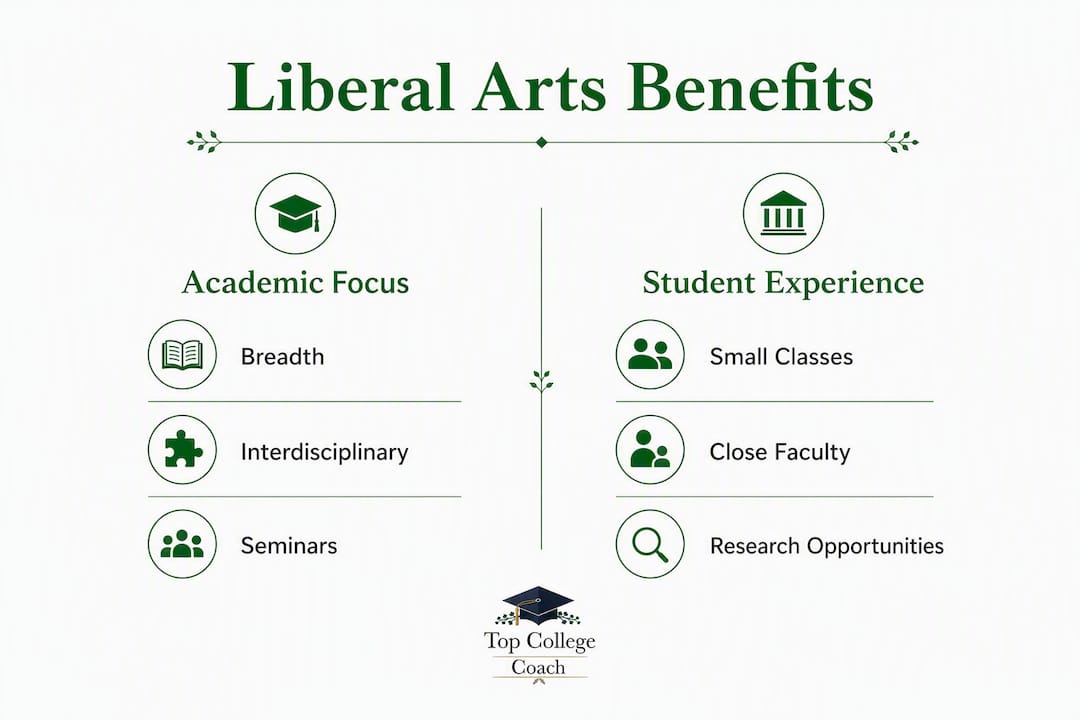
The terminology trips up most families. Here is the practical distinction:
Institution type | Typical class size | Faculty contact | Research emphasis | Curricular focus |
Liberal arts university | Small to mid-size | High; professors teach undergrads directly | Undergraduate-driven projects and thesis | Breadth + depth, seminar-heavy |
Liberal arts college | Very small | Very high; faculty mentor from year one | Senior thesis central; limited grad programs | Pure undergraduate mission |
Research university | Large | Lower; grad TAs common in intro courses | Faculty research primary; undergrads assist | Depth in major; lecture-dominant |
The key difference between a liberal arts university and a standalone liberal arts college is scale and graduate presence. A liberal arts university may house professional schools or graduate programs alongside its undergraduate college, which can dilute the seminar culture. A pure liberal arts college, by contrast, has no competing graduate mission.

For Ivy-bound applicants, the practical implication is this: at a liberal arts college, you cannot hide in a 300-person lecture. Small classroom formats make active participation non-negotiable, which means your writing and discussion skills get tested and sharpened every week.
Many of these institutions also participate in consortia like the Claremont Colleges, giving students access to larger research networks and urban internship pipelines without sacrificing the close campus community.
Does a liberal arts path help or hurt an Ivy-aspiring application?
It depends on what you bring to it. Here is an honest accounting:
Pros for Ivy-bound applicants:
Intensive writing and seminar participation produce the kind of intellectual evidence Ivy admissions readers value most.
Close faculty mentorship generates stronger, more specific recommendation letters than a large lecture environment typically allows.
A senior thesis or independent research project gives you a concrete, citable intellectual achievement.
Interdisciplinary coursework signals the intellectual range that holistic review rewards.
Risks to manage:
If your target is a STEM-heavy Ivy program, the absence of large-scale lab infrastructure may raise questions about research depth.
Rural campuses can limit internship access, though consortia and city partnerships often offset this.
Some applicants mistakenly treat liberal arts schools as a fallback rather than a deliberate choice, and admissions readers notice when “Why this school?” essays feel generic.
The strongest scenario: a student who has pursued a sustained intellectual project, writes with precision, and can articulate exactly why the seminar model fits their learning style. That student’s application to a selective liberal arts institution reads as a confident, well-reasoned choice. The weakest scenario is a student who lists a liberal arts school as a safety without engaging its pedagogy at all.
Pro Tip: Your “Why this school?” essay is where the liberal arts choice either lands or collapses. Reference a specific professor’s research, a named course sequence, or the thesis requirement — and connect it to something you have already done, not something you hope to do.
What do selective liberal-arts admissions officers actually look for?
Holistic review at selective liberal arts institutions prioritizes intellectual curiosity, community engagement, and demonstrated ability to contribute to seminar-style classes over raw metrics alone. Knowing that, here is what to build into your application:
Top admissions signals and the evidence that proves them:
Intellectual curiosity: Essays that explore a genuine question rather than announce an achievement. Recommendation letters that describe how you pushed a class discussion further than the syllabus required.
Writing readiness: A strong graded writing sample if requested; an essay that is argued, not just narrated. Courses in AP Language, AP Literature, or equivalent that show you have been trained to write analytically.
Discussion contribution: Teacher recommendations from humanities or social science courses where participation is visible. Interview answers that reference specific texts or ideas, not just general interests.
Community fit: Extracurriculars that show sustained engagement, not a résumé padded with one-semester memberships. Civic engagement and interdisciplinary projects align with the missions of schools like Amherst and Bard.
Demonstrated project work: A research paper, creative portfolio, or independent study that shows you can own a project from question to conclusion.
Understanding how applications are reviewed by admissions committees helps you sequence this evidence strategically rather than dumping everything into the activities list.
Which academic and extracurricular experiences matter most?
Priority academic experiences to pursue and highlight:
Writing seminars and advanced composition courses taken as early as sophomore year
Interdisciplinary or cross-departmental coursework (e.g., a history of science course that bridges two divisions)
Independent research with a faculty mentor, even at the high school level through university partnerships
A senior capstone, thesis, or extended project that demonstrates sustained intellectual ownership
For extracurriculars, selective liberal arts admissions readers respond to depth over breadth. One sustained leadership role in a debate team, literary magazine, or research group outweighs six clubs with no visible impact.
Arts-focused applicants should note that institutions like Bard College combine the traditional liberal arts model with high-level arts mentorship in small-class settings, making a portfolio submission a genuine differentiator rather than an afterthought.
“Students who take ownership of their education through research, hands-on projects, and senior capstones demonstrate exactly the kind of intellectual initiative that distinguishes the strongest applicants at selective liberal arts institutions.” — Reed College
Learning to describe extracurriculars precisely in your application, connecting each activity to a specific skill or intellectual question, is one of the highest-leverage moves you can make before submitting.
What does the application timeline and cost look like?
Year-by-year preparation:
Freshman year: Choose the most rigorous courses available; begin reading broadly across disciplines.
Sophomore year: Identify a faculty mentor or research opportunity; take your first advanced writing course.
Junior year: Finalize your college list, begin drafting essays, and strengthen your application by targeting any academic gaps.
Senior year: Submit Early Decision or Early Action applications by November 1–15 (most selective schools); Regular Decision deadlines typically fall January 1–15.
Financial aid basics to know:
Many top liberal arts colleges meet 100% of demonstrated financial need for admitted students.
Net price varies significantly from the sticker price; always use each school’s net price calculator before ruling out a school on cost.
Need-based aid at selective institutions can make an elite liberal arts education cost less than a flagship state university for qualifying families.
Statistic to know: According to Washington Monthly’s rankings, Williams College graduates carry a median student loan debt of $13,087 — well below national averages for four-year private institutions.
How should you evaluate and choose a liberal arts university?
Use this checklist on campus visits and when reviewing each school’s materials:
Curriculum and academic fit:
Does the school’s core or distribution requirement match how you learn best?
Are writing seminars required, and at what level?
Is a senior thesis mandatory, optional, or unavailable?
How many upper-level seminars are available in your intended area of study?
Faculty, advising, and research access:
Do professors teach introductory courses, or are those delegated to graduate students?
Are funded undergraduate research positions available, and how competitive are they?
How does the advising system work — assigned advisor, self-selected, or open?
Practical access and red flags:
Does the school participate in a consortium or have city partnerships for internships?
Ask current students: how easy is it to get a recommendation letter from a professor who actually knows your work?
Red flags: inconsistent advising, few upper-level writing courses, and scarce funded research for undergraduates signal a school that talks about the liberal arts model without fully delivering it.
Key Takeaways
A selective liberal arts university rewards applicants who demonstrate intellectual curiosity, strong writing, and seminar readiness — and those qualities must be visible in every layer of the application.
Point | Details |
Lead with writing evidence | Strong analytical writing samples and essay arguments are the single clearest signal for liberal arts admissions readers. |
Depth beats breadth in activities | One sustained, impactful extracurricular outperforms a long list of brief memberships every time. |
Research net price early | Many selective liberal arts colleges meet full demonstrated need; the sticker price is rarely what qualifying families pay. |
Know the school’s structure | Distinguish open curriculum from distributional core, and thesis-required from thesis-optional, before writing your “Why this school?” essay. |
Top College Coach advantage | Top College Coach’s former-officer application review and essay coaching help Ivy-bound applicants frame their liberal arts choice as a deliberate, competitive strength. |
What we see that most families miss
The conventional wisdom says liberal arts schools are the “thoughtful alternative” to Ivies. That framing undersells them and, more importantly, misdirects how students apply.
The real issue is that most applicants treat the liberal arts model as a backdrop rather than a thesis. They write about wanting small classes and close professors without ever demonstrating that they have already thrived in that environment. Admissions readers at Williams, Amherst, or Swarthmore are not looking for students who want the liberal arts experience. They are looking for students who have already been living it — through independent research, sustained writing projects, and intellectual conversations that go beyond the classroom.
The other thing families consistently underestimate is the recommendation letter. At a large research university, a professor writing for 200 students produces a letter that sounds like one. At a liberal arts institution, the expectation is that your recommender knows your argument, your revision process, and the specific question you are still trying to answer. If your junior-year teachers cannot write that letter for you yet, that is the gap to close before applications open.
How Top College Coach helps Ivy-bound applicants choose and apply strategically
Choosing a liberal arts path when your sights are set on highly selective schools is a high-stakes decision. Top College Coach gives you the expert guidance to make it confidently.
Our services are built specifically for students and families in this position: personalized admissions counseling, essay coaching that sharpens your intellectual argument, application review by former admissions officers who know exactly what selective readers flag, and interview preparation that trains you to discuss your ideas with precision. We work with students from early high school planning through final submission, and our track record includes admissions to Ivy League and Top 20 universities.
Personalized strategy: Your school list, your essay angles, your timeline — built around your specific profile.
Former-officer review: Real feedback from people who have sat on the other side of the admissions table.
Essay coaching: From first draft to final argument, we help you write essays that prove intellectual readiness.
Interview prep: Practice sessions that build the confidence to discuss your ideas under pressure.
Top College Coach is based in Orlando, Florida, and carries 5-star reviews from families who have been exactly where you are. Book a consultation to start building the application that makes your liberal arts choice look like the strongest move on your list.
Useful sources and further reading
Williams College — Official institutional statements on holistic admissions, seminar culture, and faculty mentorship; the primary source for admissions philosophy claims in this article.
Reed College — Authoritative source on open curriculum, mandatory senior thesis requirements, and the participation demands of small-class liberal arts education.
Vassar College — Institutional framing of liberal arts as critical thinking and adaptability development; used for core definition claims.
Amherst College — Mission statements on curiosity, civic engagement, and interdisciplinary inquiry; source for financial aid and need-based aid claims.
Kenyon College — Source for consortium and city-partnership access that extends liberal arts campus resources.
Bard College — Reference for arts-integrated liberal arts programs and small-class mentorship for creative applicants.
U.S. News 2026 Liberal Arts College Rankings — The standard liberal arts ranking reference for selectivity and institutional comparison.
Washington Monthly 2025 Liberal Arts Rankings — Alternative ranking weighted by access, affordability, outcomes, and public service; source for the Williams College debt figure cited above.
Top College Coach Blog — Further reading on essays, extracurriculars, and Ivy-focused application strategy from our counseling team.
Recommended
Comments