What Is a College Application Activity List?

Most students assume their activity list needs to feature a string of awards, varsity letters, or prestigious internships to impress admissions committees. That assumption costs real applicants real opportunities. Understanding what is a college application activity list, and more importantly how to use it strategically, can change how an admissions officer reads your entire application. This guide breaks down everything you need to know: what the list actually includes, what colleges are truly looking for, and how to build one that tells your story with confidence and clarity.
Table of Contents
Key takeaways
Point | Details |
Authenticity over prestige | Admissions officers value genuine commitment and consistency more than impressive-sounding titles. |
Strategic prioritization matters | List your most meaningful activities first and describe them with specific, impact-focused language. |
Character limits are real constraints | Common App gives you 150 characters per description, so every word must earn its place. |
Alignment strengthens your application | Your activity list should connect directly to your essays and recommendations for a cohesive narrative. |
Start documenting early | Tracking activities throughout high school prevents scrambling and produces stronger, more detailed entries. |
What the college admissions activity list actually is
The college application activity list, formally called the extracurricular activities section, is a structured portion of your application where you document your involvement outside the classroom. Think of it as a professional resume tailored for a 17 or 18-year-old. It captures the full picture of who you are when you are not sitting in a desk.
On the Common Application, the most widely used platform, you can list up to ten activities. Each entry includes a category, a position or leadership title, the organization name, a description field capped at 150 characters, the number of weeks per year and hours per week spent, and whether you plan to continue the activity in college. That 150-character limit is brutal, and intentionally so. It forces precision.
Here is a quick comparison of what belongs in the activity list versus other application sections:
Entry type | Where it goes | Examples |
Extracurricular activities | Activity list | Sports, clubs, volunteering, hobbies |
Academic honors | Honors section | National Merit, AP Scholar, Honor Roll |
Work experience | Activity list (work category) | Part-time jobs, internships, freelance work |
Awards | Honors/awards section | Essay competitions, science fair prizes |
Personal projects | Activity list (other category) | Blogs, YouTube channels, independent research |
The categories the Common Application uses include athletics, arts, career-oriented activities, community service, family responsibilities, foreign language, government and politics, journalism and publications, and more. There is even an “other” category for activities that do not fit neatly elsewhere. That last category is more useful than most students realize.
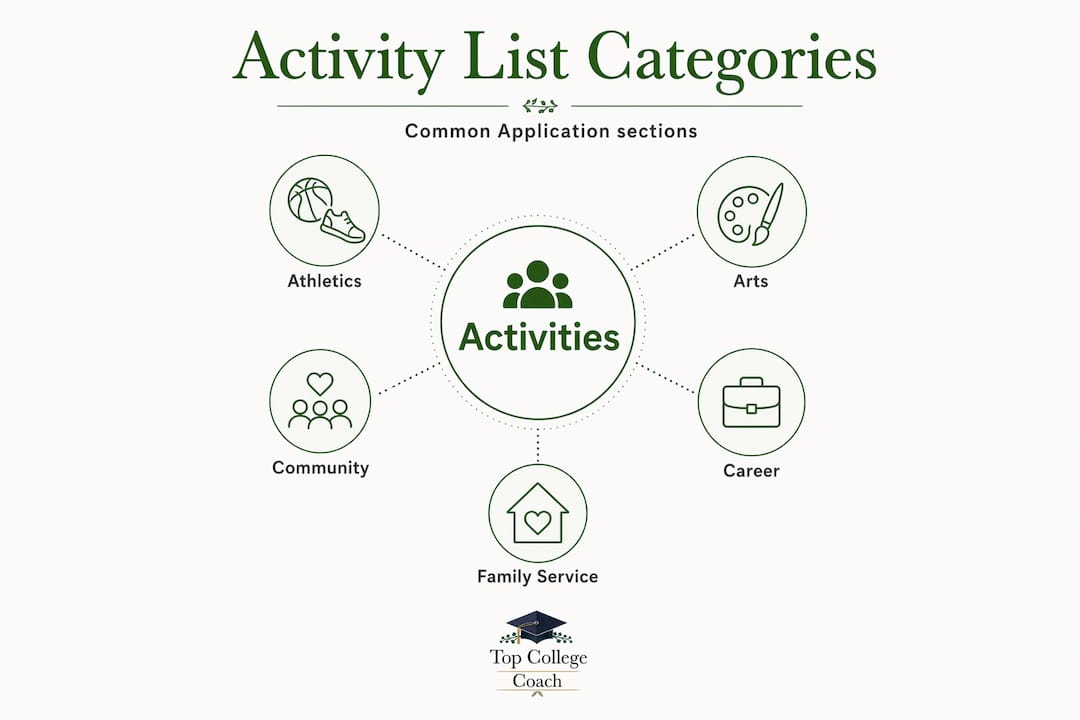
Pro Tip: If you carry significant family responsibilities, such as caring for siblings or contributing to a family business, list those. Admissions officers absolutely recognize and respect this kind of real-world contribution.
What admissions officers actually look for
Here is the part that surprises most families. Admissions officers are not counting your activities. They are reading them for evidence of commitment, growth, and character.
Colleges seek commitment, consistency, and impact in the activities a student pursues, with leadership roles valued especially highly. A student who spent four years in one choir, growing from a section member to a section leader, tells a far more compelling story than a student who joined seven clubs senior year to pad a list.
“Authentic engagement in a few meaningful activities always outperforms a long list of short-term involvements. Admissions committees are trained to spot the difference.”
What actually stands out:
Depth over breadth. Multi-year involvement in one activity shows real dedication.
Leadership trajectory. Starting as a participant and earning a leadership role demonstrates initiative.
Community impact. Volunteering demonstrates empathy and connection to something larger than yourself.
Transferable skills. Leadership roles teach communication and management skills colleges genuinely value.
Personal meaning. Activities that clearly connect to your values, curiosity, or future goals read as authentic rather than calculated.
Self-driven projects show initiative without external pressure. A student who taught herself coding and built an app for her school’s library catalog, or who started a neighborhood food drive that grew year over year, can leave a stronger impression than someone who attended every club on campus but never led anything.
A well-aligned, authentic activity list can strengthen your personal narrative and even compensate for lower test scores or academic metrics when the overall picture is compelling.
Pro Tip: Think about what your activities say collectively. Do they point toward a theme, a passion, a type of person? A cohesive identity across your list is far more memorable than a scattered one.
How to compile and organize your activity list effectively
The single biggest mistake families make is treating the activity list as something to fill out the week before the deadline. Start now, regardless of what grade you are in.
Here is a practical step-by-step approach:
Create a running activity log. Use a simple spreadsheet or notes app to record every activity, position held, approximate hours per week, and duration. Tracking activities throughout high school prevents you from forgetting details that matter at application time.
Rank by meaning and impact, not by impressiveness. Your first entry should be the activity most central to who you are, not the one that sounds most prestigious. Admissions officers read lists from top to bottom, so that first entry carries extra weight.
Write descriptions using action verbs and specific outcomes. Instead of “Helped with school newspaper,” write “Edited 12 monthly issues; increased readership 40% through social media strategy.” Concise descriptions with measurable results are consistently more effective.
Use your leadership title accurately. If you were president, say president. If you were a founding member, say that. Do not inflate, but do not undersell either.
Align your list with your essays and recommendations. If your essay focuses on how music shaped your identity, your band or orchestra role should appear prominently on the list. Aligning activities with essays and recommendations increases overall application strength by reinforcing the same narrative through multiple channels.
Draft each description and then cut ruthlessly. You have 150 characters. That is roughly one short sentence. Write the full version first, then trim until only the essential information remains.
The summer before senior year is the best time to finalize your list. For specific strategies on using that summer wisely, the team at Top College Coach has written a detailed guide on maximizing your summer before applications open.
Examples of activities and how to present them effectively
Knowing what to include is one thing. Knowing how to describe it is another. Below are examples across common categories, each showing a weak version and a stronger version.
Activity type | Weak description | Strong description |
Sports | “Played varsity soccer for three years” | “Captain, varsity soccer; led team strategy sessions; improved win rate 25% junior year” |
Community service | “Volunteered at food bank” | “Sorted 500+ lbs of donations weekly; trained 8 new volunteers; served 200 families” |
Creative arts | “In school play” | “Lead role, fall musical; 4 consecutive years; coached younger cast members backstage” |
Part-time work | “Worked at coffee shop” | “Barista, 15 hrs/week; managed weekend opening shift; trained 3 new staff members” |
Personal project | “Runs a blog” | “Founded sustainability blog; 1,200 monthly readers; published in local newspaper twice” |
Work experience demonstrates responsibility and career focus in a way clubs often cannot. Students who hold part-time jobs while maintaining strong academics are demonstrating time management in practice, not just on paper.

Team captain roles demonstrate the ability to motivate peers and lead under pressure, two qualities every college wants to see in its incoming class. If you held that role, make sure it reads clearly in your title field and your description.
The key across all categories is specificity. Numbers, titles, and concrete outcomes turn a vague entry into a vivid one.
Common pitfalls that weaken activity lists
Even motivated, high-achieving students make these mistakes more often than you would expect.
Quantity over quality. Overloading the list with shallow entries is less effective than showing genuine depth in fewer activities. Ten mediocre entries hurt more than they help.
Vague or passive descriptions. Phrases like “participated in” or “was involved with” signal minimal contribution. Use active, specific language every time.
Ignoring character limits. Descriptions that run over the limit get cut off automatically. The sentence an officer sees may end mid-word if you have not proofread inside the platform.
Inconsistency with the rest of the application. If your essay talks about your passion for environmental advocacy but it appears nowhere on your activity list, that disconnect raises questions.
Last-minute construction without review. A rushed list shows. Descriptions are thin, titles are missing, and the ordering feels random.
Pro Tip: Have a parent, counselor, or trusted teacher read your completed activity list alongside your main essay. Ask them: does this feel like the same person? If the answer is uncertain, revisit the alignment.
A perspective on what the activity list really does for you
I have worked with hundreds of students applying to Ivy League and top-20 universities, and the pattern I see most often is this: students who treat the activity list as a checkbox exercise lose something they never know they had.
The activity list is not a resume. It is the first place an admissions reader starts forming an opinion of who you are as a person. Before they read your essay, before they scan your grades, they may glance at those ten entries and begin constructing a mental image of you.
What I have learned is that the students who get in are not always the ones with the most impressive activities. They are the ones whose lists feel coherent. Every entry points somewhere. There is a story being told even without the essay. When the essay arrives, it feels like confirmation of something the reader already sensed.
I tell every student I work with: write your activity list first, then write your essay. The list clarifies your own narrative in a way that makes the essay dramatically easier to write. It forces you to ask, “What have I actually done? What do I actually care about?” Those are the right questions.
Start early, document honestly, and trust that your real story is compelling enough. It almost always is.
— Randy Pryor, Founder - Top College Coach Admissions Counselor
Work with Top College Coach to strengthen your application
At Top College Coach, we have helped students from across the country craft activity lists that complement every other piece of their application, from essays to recommendation letters to interview preparation.
Whether you are a sophomore thinking ahead or a senior finishing your list this fall, personalized guidance makes a real difference. Our counselors review your activity descriptions, help you prioritize strategically, and align your list with the story your entire application is telling. Families who work with us gain clarity, confidence, and a proven approach to top-tier college admissions. The first step is simple. Book your free admissions strategy session and find out exactly how your activity list can work harder for you.
FAQ
What is a college application activity list?
The college application activity list is a structured section of your application, most often found on the Common Application, where you document up to ten extracurricular activities, jobs, volunteer work, and personal projects. It gives admissions officers a direct view of how you spend your time outside school.
How many activities should I include on my list?
Quality matters far more than quantity. Most strong applicants list between six and ten activities, with an emphasis on depth and consistency rather than sheer volume. Depth in fewer activities is consistently more persuasive to admissions committees.
Can a job or family responsibility count as an activity?
Absolutely. Part-time jobs, internships, and significant family responsibilities all belong on the activity list. Work experience is highly regarded for demonstrating responsibility, time management, and maturity.
How do I make my activity descriptions stand out?
Use specific action verbs, include measurable outcomes when possible, and keep every word purposeful within the 150-character limit. An entry like “Founded robotics club; grew membership from 5 to 40 students over two years” tells a clear story in seconds.
When should I start building my activity list?
Start tracking activities as early as ninth or tenth grade. Early and ongoing documentation produces far stronger, more detailed entries than trying to reconstruct four years of involvement the week before your applications are due.
Recommended
What Top Colleges Are Looking in Applications From Top College Coach
Top College Coach Reveals What Colleges Look for in Students: A Guide to College Admissions Criteria
College Admissions Counselor | Top College Coach | Ivy Admissions
College Admissions Counselor | Top College Coach | Admissions Advice
Comments