College Admissions Timeline: A 2026 Parent & Student Guide

The college admissions timeline is defined as the structured sequence of preparation steps, application deadlines, and decision milestones that students must follow from junior year through senior year to gain college acceptance. This cycle includes standardized testing windows, the opening of platforms like the Common Application, Early Decision and Early Action deadlines in fall, Regular Decision deadlines in winter, FAFSA submission, and the final enrollment commitment by May 1. Knowing what is college admissions timeline means knowing exactly when to act, and acting too late is the single most common reason strong students miss their best opportunities.
What is the college admissions timeline, phase by phase?
The college admissions cycle runs roughly 18 months, starting in junior year and ending with an enrollment deposit in senior spring. Each phase builds on the previous one, so falling behind early creates compounding pressure later.

Phase 1: Junior Year (September through May)
Junior year is the foundation of your entire application. Here is what needs to happen:
Register for the PSAT in October to qualify for National Merit consideration and benchmark your scores.
Take the SAT or ACT at least once by spring of junior year, leaving room for a retake in fall senior year.
Build your college list by researching schools across reach, match, and safety categories. Tools like the Common Application portal list over 1,000 member schools.
Begin tracking your extracurricular activities and academic achievements for your application narrative.
Phase 2: Summer Before Senior Year (June through August)
This is the most underused window in the entire process. Use it well:
Finalize your college list, ideally 10–15 schools.
Draft your Common App personal statement and school-specific supplements.
Request letters of recommendation from teachers and counselors before school ends in June. Asking in September is too late for Early Decision applicants.
Research summer preparation strategies that strengthen your application before deadlines arrive.
Phase 3: Early Fall Senior Year (August through November)
College applications open August 1, with Early Action and Early Decision deadlines commonly falling in October or November. This is the busiest stretch of the entire timeline. Submit Early Decision or Early Action applications, finalize test scores, and complete the FAFSA, which opens October 1 each year.
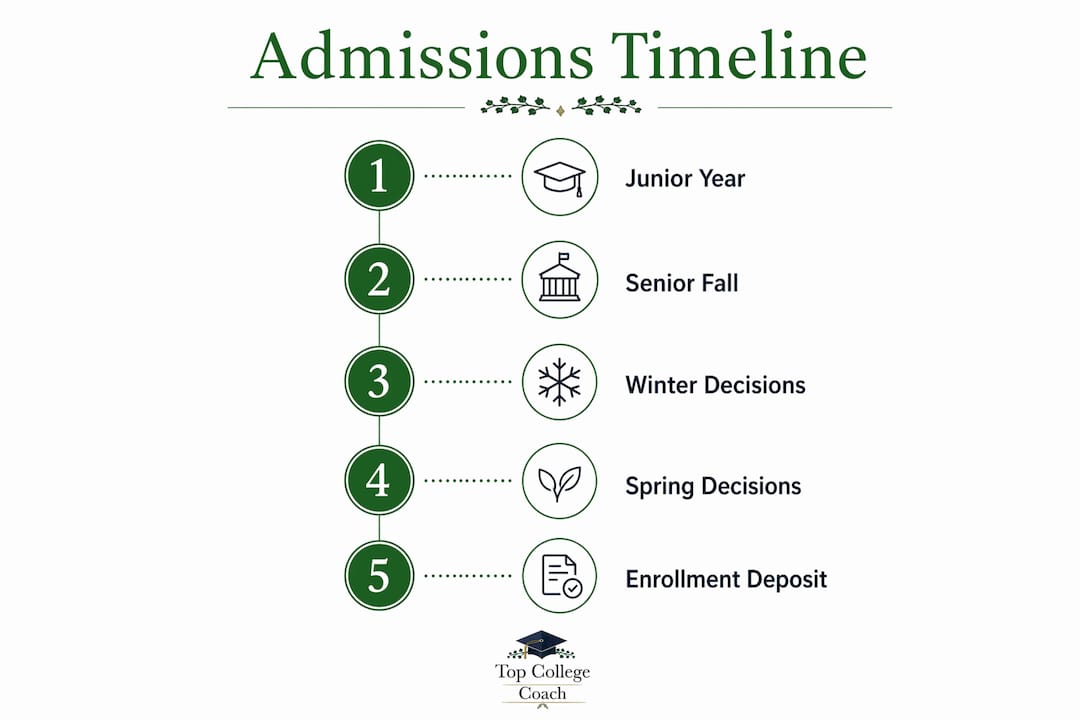
Phase 4: Winter (December through February)
Early Decision and Early Action decisions arrive in mid-December. Students who are deferred or denied shift focus to Regular Decision applications, most of which are due in December or January. The CSS Profile for financial aid at private schools is also due during this window.
Phase 5: Spring (March through May)
Regular Decision notifications arrive between late March and early April. You then compare financial aid offers, visit campuses if possible, and commit to one school by may 1, the National Decision Day deadline.
How do early decision, early action, and regular decision differ?
Understanding the differences between application types is one of the most consequential decisions in the entire admissions process. Each pathway carries different deadlines, commitment levels, and strategic implications.
Application Type | Typical Deadline | Notification | Binding? |
Early Decision (ED) | November 1–15 | Mid-December | Yes |
Early Action (EA) | November 1–15 | Mid-December | No |
Regular Decision (RD) | January 1–15 | Late March–April 1 | No |
Rolling Admissions | Varies (Aug–May) | 4–6 weeks after submission | No |
Early Decision is a binding agreement. You apply to one school as your clear first choice, and if admitted, you withdraw all other applications and enroll. Expert counselors confirm that Early Decision is best suited for students with a clear top choice who want to leverage the admission advantage that comes with demonstrated commitment.
Early Action gives you the same November deadline and mid-December notification without the binding commitment. It is a strong strategic move for students who are ready early but want to keep their options open.
Regular Decision is widely misunderstood. Many students treat it as a relaxed fallback, but top schools fill a significant portion of their class through Early Decision rounds. That means Regular Decision applicants face a smaller pool of available spots and often stronger competition. Regular Decision is not simply a more flexible version of the same opportunity.
Rolling Admissions schools review applications as they arrive and notify applicants within 4–6 weeks of receiving a complete file. Applying early in the rolling window, ideally in August or September, gives you the best odds before seats fill.
Pro Tip: If a school is your clear first choice and your application is strong, Early Decision is almost always the right move. The admission advantage is real, and the binding commitment signals exactly the kind of authentic interest top schools reward.
What steps should students and parents take to stay on track?
Managing the college admissions process effectively comes down to one principle: set your own deadlines two weeks ahead of every official one. Here is how to put that into practice.
Start test prep in sophomore or early junior year. The SAT and ACT require months of preparation. Waiting until fall senior year leaves no room for a retake.
Ask for recommendation letters in June, not September. Teachers write better letters when they have time. Asking at the start of senior year puts you in a long queue.
Submit applications 24–48 hours before the deadline. Server crashes on deadline day are common, and universities do not grant extensions for technical failures.
Use a shared calendar. Google Calendar or a printed wall calendar with every deadline color-coded by school keeps both students and parents aligned.
Submit the FAFSA as early as possible after October 1. Financial aid is often awarded on a first-come, first-served basis. Waiting until January costs families real money.
Complete the CSS Profile for private schools by each school’s specific deadline, which often falls before the Regular Decision application deadline.
Track recent admissions changes that may affect deadlines or requirements for the 2026–2027 cycle.
Pro Tip: Create a master spreadsheet with every school’s application portal login, deadline dates for the application, financial aid forms, and any supplemental materials. Review it every Sunday morning during senior fall. Fifteen minutes a week prevents a semester of panic.
Many families underestimate how fast senior fall moves once school starts. Early planning is the single most reliable predictor of a smooth, low-stress application season.
How do you respond to admission decisions after submitting?
The college acceptance timeline does not end when you hit submit. What you do after decisions arrive is just as important as the applications themselves.
When decisions arrive:
Early Decision and Early Action results come in mid-December. If admitted Early Decision, you must withdraw all other applications promptly.
Regular Decision results arrive between late March and early April. Most schools set April 1 as their notification date.
Rolling admissions schools respond within 4–6 weeks of a complete application, so you may hear back from these schools as early as September or October of senior year.
Comparing offers:
Once you have multiple acceptances, compare financial aid award letters carefully. The sticker price and the net price after grants and scholarships are often very different numbers. Use the college choice framework to weigh academics, cost, culture, and career outcomes together.
The May 1 commitment:
Most Regular Decision deadlines lead to a May 1 National Decision Day enrollment deposit. This is the final step in the college admissions cycle. Submit one deposit, to one school, by May 1.
Double depositing at more than one school is unethical and can result in rescinded offers from every school involved. Colleges share this information. The risk is not worth it.
Decision Type | Notification Window | Deposit Deadline |
Early Decision | Mid-December | Within 2–3 weeks of admission |
Early Action | Mid-December | May 1 |
Regular Decision | Late March–April 1 | May 1 |
Rolling Admissions | 4–6 weeks after submission | Varies by school |
Key takeaways
The college admissions timeline is a fixed sequence of phases beginning in junior year, and students who plan each phase at least two weeks ahead of official deadlines consistently outperform those who react to deadlines as they arrive.
Point | Details |
Start in junior year | Register for the PSAT and SAT/ACT early to leave room for retakes before senior fall. |
Summer is critical | Draft essays and request recommendation letters before senior year begins in September. |
Know your application type | Early Decision offers an admission advantage but requires binding commitment to your top choice. |
Submit early, not on time | Submit applications 24–48 hours before deadlines to avoid server failures that schools will not excuse. |
Honor the May 1 deadline | Submit one enrollment deposit by May 1 and never double deposit, as it can cost you every offer. |
The part of the timeline most families get wrong
By Randy Pryor
After working with hundreds of students and families through the admissions process, the pattern I see most often is not procrastination. It is false confidence in the Regular Decision timeline. Parents and students tell themselves they have until January, so they spend the fall in a low-urgency mode. Then November arrives, and they realize the students who applied Early Decision to their dream schools are already done. The best spots at selective schools are already spoken for.
The college admissions cycle is not a single race with one finish line. It is a series of sprints, each with its own cutoff. Missing the first sprint does not disqualify you, but it does change the math. I have seen students with genuinely strong profiles get shut out of their top choices simply because they applied Regular Decision to schools that had already filled 40–50 percent of their class through Early rounds.
My honest advice: treat the Early Decision or Early Action deadline as your primary deadline, not a bonus option. If you are not ready by November, that is a signal to look at your preparation timeline, not a reason to default to January. The students who come to Top College Coach early in junior year consistently have more options, less stress, and better outcomes. Starting the process in September of senior year is not late. It is already behind.
— Randy Pryor, Founder - Top College Coach
Work with top college coach to plan your timeline
Knowing the timeline is one thing. Executing it with precision, especially when balancing school, testing, and life, is where most students need support.

Top College Coach works with students and families from junior year through enrollment, building a personalized admissions strategy that accounts for every deadline, every application type, and every school on your list. With a proven track record of placements at Ivy League and Top 20 universities, our counselors in Orlando, Florida have helped students across the country turn a stressful process into a confident one. Book your free admissions strategy session today and get a clear picture of your timeline before the clock starts running. Visit Top College Coach to learn more about how we can help you plan every phase of the admissions cycle.
FAQ
What is the college admissions timeline?
The college admissions timeline is the structured sequence of milestones from junior year through senior spring, covering standardized testing, application submissions, financial aid deadlines, admission decisions, and the final enrollment commitment by May 1.
When do early decision and early action decisions come out?
Early Decision and Early Action admissions decisions are typically released in mid-December, shortly after the October or November application deadlines.
What is the regular decision deadline and when do decisions arrive?
Most Regular Decision applications are due in December or January, with decisions released between late March and early April and enrollment deposits due by May 1.
How long does rolling admissions take?
Rolling admissions schools notify applicants within 4–6 weeks of receiving a complete application, making early submission in August or September the strongest strategic move.
Is double depositing at two colleges allowed?
Double depositing is unethical and can result in rescinded admission offers from every school involved. Students must submit one enrollment deposit to one school by May 1.
Recommended
Comments