How to Make an Impact in Your Community: A Student Guide
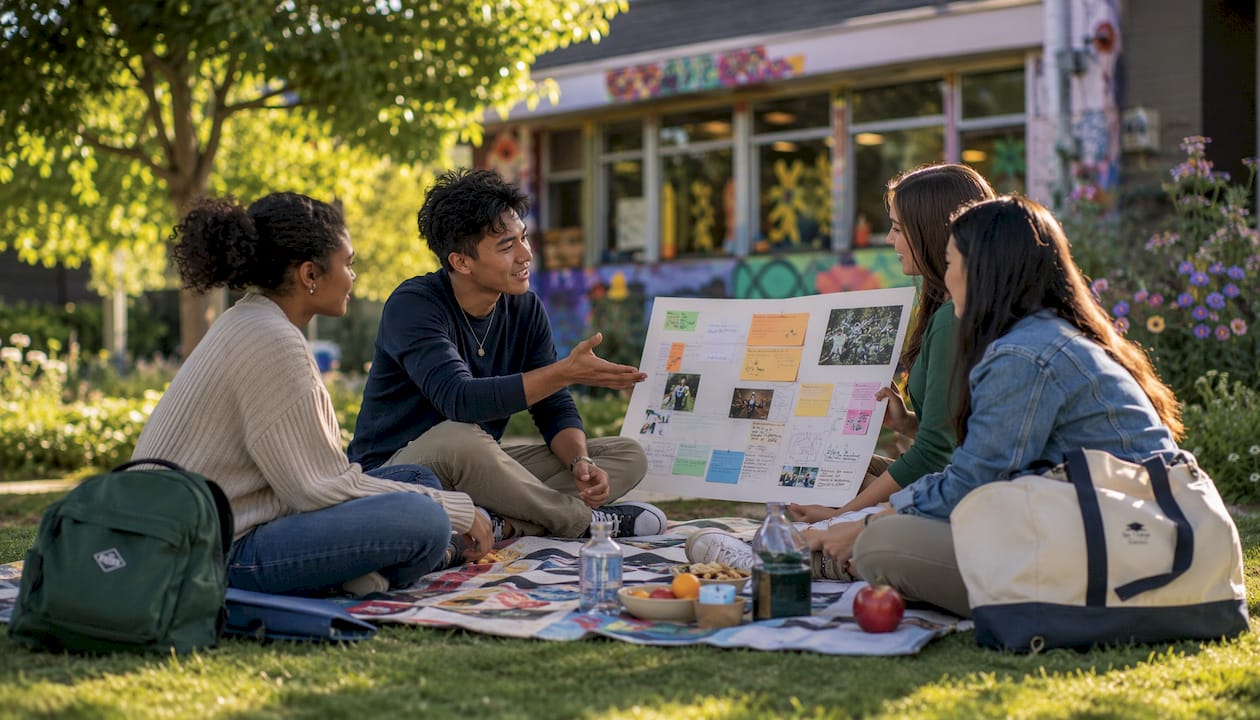
Start small, listen first, run one pilot project, and document every outcome. That four-step sequence is the foundation of community impact that Ivy League and Top 20 admissions officers actually respect. Here is a starter plan you can launch in the next 30 days:
Week 1: Conduct three short conversations with neighbors, teachers, or local organization leaders to identify one unmet need (30 minutes total).
Week 2: Design a micro-pilot around that need. Aim for one measurable outcome, such as hours tutored, meals delivered, or attendees at a cleanup.
Weeks 3–4: Run the pilot with two to five peers. Log hours, collect one photo with consent, and note a before/after observation.
Ongoing: Commit to at least two hours per week and one documented metric per month.
CDC community engagement principles, the 80,000 Hours multiplier framework, and Top College Coach all point to the same truth: sustained, evidence-backed local action outperforms a single high-profile volunteer day every time.
Table of Contents
Why selective colleges care about your community impact
Admissions officers at Ivy League and Top 20 schools are not counting volunteer hours. They are reading for evidence of leadership, initiative, measurable change, and honest reflection. Those four signals, taken together, tell a reader whether a student drove something or simply showed up.
What separates authentic impact from resume padding? Duration, specificity, and verification. A project that ran for six months, produced a countable result, and can be confirmed by a partner organization reads entirely differently from a one-day beach cleanup listed without context. The key traits top colleges value include intellectual curiosity and agency, and community work is one of the clearest places to demonstrate both.
Here is how the same project reads at two different levels of description:
Weak: “Volunteered at a food bank on weekends.”
Stronger: “Organized a monthly food distribution at a local pantry, coordinating several student volunteers and serving many families per session over an extended period.”
Strongest: “Identified a gap in weekend food access, recruited eight peers, and built a distribution system that served 40 families per session. Partnered with the pantry director to track inventory reduction and wrote a reflection on what I learned about systemic hunger.”
The third version shows what top colleges look for: a student who noticed a problem, acted on it, measured the result, and grew from the experience.
Ethical principles every student must follow
Ethical community engagement protects the dignity of the people you serve and, frankly, makes your project more credible to admissions readers. The ATSDR/CDC principles are the clearest framework available: listen before acting, build genuine partnerships, respect community history and cultural context, and sustain relationships beyond a single event.
Listen first. Spend time understanding what the community actually needs before designing a solution.
Co-create, don’t impose. Involve community members in planning decisions, not just execution.
Respect history and diversity. A project that ignores a neighborhood’s context can do more harm than good.
Build trust over time. One meeting is not a partnership. Consistent presence is.
Become a multiplier. Mobilizing peers to act often creates more impact than solo hours, according to 80,000 Hours.
Start where you are. Small, local actions reduce paralysis and build the habits that scale.
Pro Tip: Before your first community meeting, prepare a 10-minute listening script: three open questions about needs, one question about existing efforts, and a simple opt-in line for photos or data (“May I photograph this event and use the image in a school project?”). That script alone signals maturity to any partner organization.

Practical project ideas you can start this month
Pick a project that fits your schedule and skills, then commit to it long enough to measure something real. Projects fall into four categories by scale:
Micro (neighbor-to-neighbor, 1–2 hrs/week)
Grocery runs or meal delivery for elderly neighbors. Metric: households served per month.
Tool-lending or ride-sharing network on your block. Metric: requests fulfilled.
Reading buddy program for one younger student. Metric: sessions completed, reading level change.
Short-term (school-based, 2–3 hrs/week for 4–8 weeks)
Tutoring pilot in one subject for five classmates. Metric: quiz score improvement.
Park or trail cleanup series. Metric: pounds of trash collected, repeat attendance.
Mental health awareness bulletin board campaign. Metric: student surveys before and after.
Medium (multi-month, 3–5 hrs/week)
After-school STEM club for middle schoolers. Metric: enrollment growth, projects completed.
Small business mentoring pop-up for local entrepreneurs. Metric: participants, follow-up consultations.
Community garden plot with a local nonprofit. Metric: produce harvested, families served.
Scale (community partnerships, 4–6 hrs/week)
Youth advisory council for a local organization. Metric: policy recommendations submitted.
Community-focused student travel or service-learning program. Metric: partner hours, documented outcomes.
Informal actions count too. Sharing rides, lending tools, and checking on neighbors are gateways to deeper civic engagement and can be structured into application-ready evidence with a simple activity log.
How to plan, run, and sustain your project
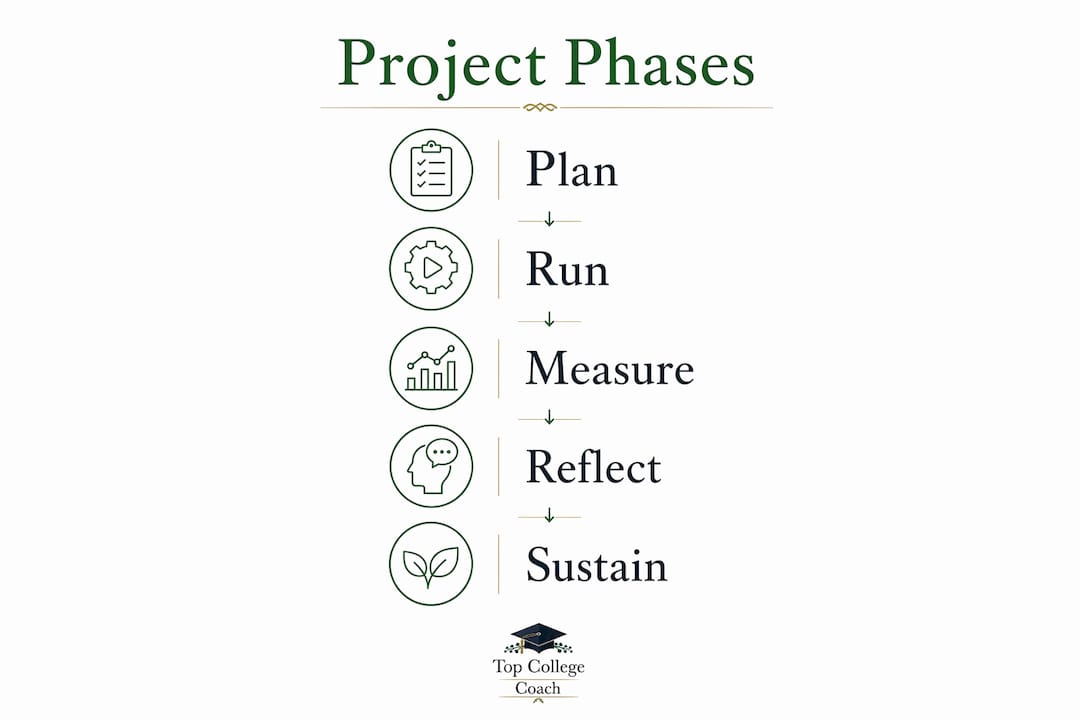
A four-phase framework keeps any project on track from idea to application documentation.
Plan (Weeks 1–2). Define one problem, one measurable goal, and two to five partners or participants. Write a one-paragraph purpose statement.
Pilot (Month 1). Run a small version. Track attendance, hours, or units served. Collect one photo with consent and one partner email confirming your role.
Evaluate (Month 2). Compare your metric to your baseline. Adjust the approach based on feedback. Document what changed and why.
Sustain (Months 3–12). Recruit additional participants, formalize a schedule, and capture a partner testimonial. Align major milestones with application deadlines.
Phase | Timeline | Key Metric Example | Documentation |
Plan | Weeks 1–2 | Baseline survey (participants not specified) | Purpose statement, partner list |
Pilot | Month 1 | 5 participants, 8 hrs logged | Activity log, consent photo |
Evaluate | Month 2 | 20% attendance increase | Feedback notes, partner email |
Sustain | Months 3–12 | 40+ hrs, 3 partner testimonials | Final log, testimonial prompts |
Consistent, documented engagement builds the trust and outcomes that top colleges recognize. A project running six months with clear metrics is worth more on an application than three separate one-day events.
How to translate your project into application materials
Turn project facts into a narrative of responsibility, outcomes, and growth. Every strong activity entry, essay, and interview answer needs three components: what you did, a measurable result, and a personal reflection.
Sample activity-list entries:
Micro: “Weekly grocery delivery for four elderly neighbors; 9 months, 2 hrs/week; reduced isolation for homebound residents.”
Medium: “Founded after-school tutoring program; recruited 6 peer tutors; served 18 students over one semester; average quiz scores rose 15%.”
Sustained: “Co-led monthly food distribution with local pantry; coordinated 8 volunteers; served 40 families/session across 7 months.”
Essay skeleton: Hook (one vivid scene) → concrete action you took → evidence or metric → what you learned → how it shapes your future plans. A strong hook sounds like: “The first time I knocked on Mrs. Rivera’s door with groceries, I realized I had been solving the wrong problem.”
For polishing your essay narrative, the college essay guide from David TC Tutoring Services offers practical structure advice worth reading alongside Top College Coach’s own essay coaching resources.
Do | Don’t |
Use specific numbers (hours, people served, months) | Claim sole credit for a group effort |
Show what you learned or changed | Exaggerate outcomes you cannot verify |
Name your community partner | List the project without context or metrics |
Reflect on a failure or pivot | Use vague language (“helped many people”) |
Common pitfalls that weaken your application
Some well-intentioned efforts weaken, rather than strengthen, an application. Here are the biggest red flags and how to fix them:
Performative one-offs. A single volunteer day with no follow-up signals availability, not commitment. Remedy: add two more sessions and document them.
Overstating results. Claiming you “transformed” a community without evidence invites skepticism. Remedy: use precise, verifiable numbers.
No documentation. Undocumented work is unverifiable work. Remedy: start an activity log today, even retroactively.
Taking over instead of partnering. Projects designed without community input often fail or cause harm. Remedy: add a co-creation step and name your community partner.
Ethics or consent failures. Posting photos of minors or vulnerable adults without consent is both unethical and a liability. Remedy: use a simple opt-in line at every event.
Pro Tip: Parents, before committing time or money to a project, ask these three questions: Does the community actually want this? Can we measure one outcome? Will this still be running in six months? If any answer is no, redesign before launching.
Your 12-month checklist from idea to application
Follow this sequence to move from first idea to application-ready documentation:
[ ] Month 1: Conduct three listening conversations; identify one unmet need.
[ ] Month 1: Define one measurable goal and recruit two to five peers.
[ ] Month 2: Run your pilot; log hours and collect one consent photo.
[ ] Month 3: Evaluate your metric; gather one partner email or testimonial.
[ ] Months 4–6: Iterate based on feedback; expand to additional participants.
[ ] Month 6: Write a mid-point reflection (one paragraph) for your essay file.
[ ] Months 7–9: Sustain the project; collect a formal partner testimonial.
[ ] Month 10: Compile your activity log, photos, and metric snapshots.
[ ] Month 11: Draft your activity-list entry and essay hook.
[ ] Month 12: Polish materials; align with early action or regular decision deadlines.
Align your Month 6 reflection with summer essay drafting, and your Month 10 documentation with the Common App opening in August.
Key Takeaways
The simplest path to meaningful community impact starts local, sustains for months, measures one clear outcome, and reflects honestly on what changed.
Point | Details |
Start local and small | Neighbor-to-neighbor actions build habits and credibility faster than large one-off events. |
Measure one clear metric | Track hours, people served, or a before/after score to make impact verifiable on applications. |
Sustain for months, not days | A six-month project with consistent documentation outweighs three separate single-day events. |
Document and reflect | Activity logs, consent photos, and partner testimonials turn volunteer work into admissible evidence. |
Top College Coach support | Top College Coach helps students translate sustained community work into compelling application narratives. |
Why starting small is the smartest admissions move
Here is something we see repeatedly at Top College Coach: students who launch ambitious, large-scale projects in junior year often produce thinner application narratives than students who started a modest tutoring program in ninth grade and stuck with it. The admissions reader is not impressed by the size of the idea. They are moved by evidence of growth over time.
The conventional wisdom says “do something big and impressive.” We disagree. A student who spent two years building a neighborhood tool-lending library, documented the number of households served, and can speak in an interview about what they learned about trust and community organizing is a more compelling applicant than one who organized a single fundraiser that raised a large sum but ended after one weekend.
Small, sustained projects also give you more material. You accumulate stories, pivots, failures, and lessons. Those are the raw ingredients of a great college essay. A one-day event gives you one anecdote. A year-long project gives you a character arc.
Top College Coach can help you build your admissions story
Turning genuine community work into a standout application takes more than good intentions. It takes strategic framing, precise language, and an understanding of what admissions officers at specific schools actually want to see.
Top College Coach works with students and families to develop community projects that align with their authentic interests, document outcomes in application-ready formats, and craft essays and activity entries that reflect real growth. Our team includes former admissions officers and current Ivy League student mentors who know exactly how impact reads on the page. Services cover project planning, essay coaching, activity-list writing, and full interview preparation.
Based in Orlando, Florida, with a track record of placements at Ivy League and Top 20 universities and a consistent five-star client rating, Top College Coach offers personalized consulting packages for families who want expert guidance from the beginning. Schedule a consultation to start building your student’s application story today.
Useful sources and Top College Coach resources
Research and ethics sources:
CDC/ATSDR Principles of Community Engagement, 3rd Edition
80,000 Hours: How anyone can have an impact
Stand Together: 7 real ways to serve your community
RYTHM Foundation: Community Advocacy Toolkit
How to Be Part of the Solution in Your Own Community
Top College Coach blog posts:
What top colleges are looking for in applications
Why extracurriculars matter in college applications
Key traits and qualities top colleges value
Why college essays matter in admissions
Recommended
Comments