Why Extracurriculars Matter in College Applications

Extracurricular activities are a primary non-academic differentiator in college admissions, giving you the chance to prove who you are beyond your GPA and test scores. Understanding why extracurriculars matter in college applications is the first step toward building a profile that stands out at selective universities. Admissions officers at Ivy League and Top 20 schools read thousands of applications from students with near-perfect grades. Your activities section is where your character, initiative, and leadership become visible. At Top College Coach, we see this distinction shape outcomes every admissions cycle.
Why extracurriculars matter in college applications
Extracurricular involvement signals agency, and agency is exactly what selective colleges are looking for. Admissions officers at highly selective universities use extracurricular profiles to identify students who can function independently beyond academics. That means students who build projects, take responsibility, and solve problems without being told to do so.
The importance of extracurriculars goes beyond padding a resume. Activities reveal personal qualities that grades simply cannot capture: resilience, creativity, and the ability to lead others toward a shared goal. These are the qualities that predict success in college and career, and admissions readers are trained to spot them.

Colleges also use extracurriculars to assess fit. A student who has spent three years leading a community garden program tells a very different story than one who joined five clubs in senior year. The depth of your commitment signals that you will bring that same energy to campus life, research labs, and student organizations.
How colleges evaluate extracurricular activities
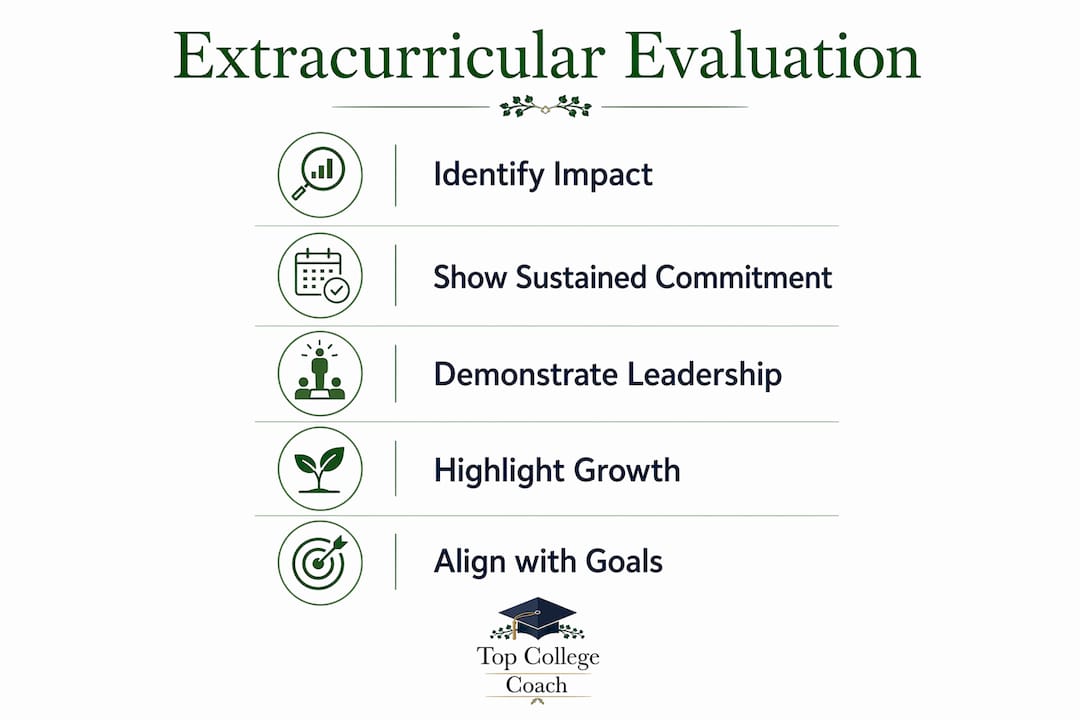
Admissions officers do not simply count your activities. They read for evidence of growth, impact, and self-direction across your entire profile.
Here is what they look for most:
Agency and initiative. Did you start something, or did you join something that already existed? Both matter, but creating a new initiative carries more weight.
Measurable impact. How many students did your tutoring program serve? How much money did your fundraiser raise? Concrete results make your story credible.
Sustained commitment. A four-year involvement in one activity outweighs four one-year memberships in four different clubs.
Leadership with influence. Leadership is measured by initiative, impact, and influence, not titles. Applicants who build replicable programs or scalable initiatives stand out more than those with multiple superficial roles.
Social-emotional development. A 2026 peer-reviewed study finds that specific extracurriculars like sports and volunteering improve adolescent social-emotional outcomes. Colleges value these qualities because they predict how well you will collaborate and adapt on campus.
Pro Tip: When describing your activities, lead with what changed because of your involvement. “Grew the robotics team from 8 to 34 members” is far more compelling than “served as robotics team captain.”
Common misconceptions about extracurricular leadership
The biggest myth in college admissions is that collecting leadership titles makes you a strong applicant. It does not. Admissions officers recognize the difference between holding a title and creating real change.
Here are the most common mistakes students make:
Stacking titles without impact. Being president of five clubs in senior year signals resume-building, not genuine passion. Officers see this pattern constantly, and it rarely helps.
Joining activities late. Joining a club in 11th or 12th grade just to list it on your application reads as opportunistic. Sustained involvement from earlier years carries far more weight.
Confusing participation with leadership. Attending meetings is participation. Redesigning how meetings run, recruiting new members, or launching a new initiative is leadership.
Prioritizing prestige over passion. Students who pursue activities they think colleges want, rather than activities they genuinely care about, struggle to write compelling essays about them. Authenticity is detectable.
Ignoring durability. Leadership that persists beyond a student’s graduation signals systems thinking. Building a structure that outlasts your involvement shows deeper influence than a role that disappears when you leave.
“True leadership is defined by initiative, impact, and influence, not by holding a title. Creating something new or significantly improving a system is valued more than occupying existing titles.”
This distinction matters because it changes how you should spend your time in high school. One well-built program that solves a real problem is worth more than a dozen club memberships on your activity list.
How to choose and showcase extracurriculars strategically
Choosing the right activities starts with honest self-reflection. Ask yourself what you genuinely care about, what problems you want to solve, and where you have already shown initiative. Your answers will point you toward activities that produce authentic stories.
Build depth in 3–4 core activities
Admissions experts advise sticking to 3–4 meaningful activities with sustained involvement and measurable achievements. Depth and measurable impact consistently outperform quantity. Choose activities where you can grow into a leadership role, create something new, or produce a result you can describe in concrete terms.
Align activities to your personal narrative
Your extracurriculars should connect to a coherent story about who you are and where you are headed. A student interested in environmental policy might combine debate team, a local conservation volunteer role, and a self-started recycling initiative at school. Each activity reinforces the same core identity. That coherence makes your application memorable.
Document your impact as you go
Do not wait until senior year to reconstruct what you accomplished. Keep a running log of milestones: members recruited, funds raised, events organized, and problems solved. This documentation feeds directly into your college application activity list and your personal statement.
Frame achievements in essays and interviews
Admissions increasingly seek evidence of sustained commitment and growth through essays and interviews, not just a list of titles. Use your personal statement to show what you learned, how you failed and recovered, and what you built. Interviewers ask follow-up questions, so you need to own your story completely.
Presentation approach | What it signals to admissions |
Lists titles only | Surface-level involvement, resume padding |
Describes role and duration | Commitment, but limited depth |
Quantifies impact and growth | Agency, leadership, and measurable results |
Connects activity to future goals | Self-awareness and intentional trajectory |
Pro Tip: Use the Common App activities section to lead with your most impressive result, not your job title. You have 150 characters per activity. Make every word count.
How to balance extracurriculars with academics and well-being
Extracurricular involvement improves academic performance when managed well. Students involved in extracurriculars achieve higher grades, better attendance, and improved time management, which motivates broader academic success. Student activities also reduce dropout risk and build concentration skills that carry into college coursework.
The social-emotional benefits are equally real. The 2026 study on extracurricular participation links involvement to increased well-being and better functioning, including for students with ADHD. Structured activities provide routine, social connection, and a sense of purpose that supports mental health during a stressful period.
The risk comes from over-commitment. Excessive extracurricular hours beyond 3–4 activities may not improve and might reduce admission prospects due to perceived over-commitment and lack of focus. Spreading yourself too thin signals poor judgment, not ambition.
Involvement level | Academic and well-being outcome |
1–2 meaningful activities | Positive impact on focus and motivation |
3–4 sustained activities | Strongest outcomes for GPA and well-being |
5+ activities with shallow roles | Risk of burnout and weaker application profile |
Pro Tip: Plan your extracurricular calendar the same way you plan your academic schedule. Block time for activities, homework, and recovery. Students who treat their schedule as a resource, not an obstacle, perform better in both areas.
Key Takeaways
Extracurricular activities strengthen college applications when they demonstrate sustained commitment, measurable impact, and authentic leadership rather than a long list of titles.
Point | Details |
Agency over titles | Admissions officers value initiative and problem-solving, not the number of roles held. |
Depth beats quantity | Focus on 3–4 sustained activities with concrete, documented results. |
Durability signals leadership | Programs that outlast your involvement show systems thinking and real influence. |
Frame impact in essays | Use your personal statement and activity list to quantify results and show growth. |
Balance protects performance | Overcommitting beyond 3–4 activities can hurt both your well-being and your application. |
What I have learned guiding students through this process
After working with hundreds of students at Top College Coach, one pattern stands out clearly. The students who gain admission to Ivy League and Top 20 schools are rarely the ones with the longest activity lists. They are the ones who can tell a specific, honest story about something they built, changed, or improved.
Parents often push students toward prestigious-sounding activities, and I understand the instinct. But a student who spent two years building a peer tutoring network at their school tells a more compelling story than one who attended a summer program at a well-known university. Admissions officers read both. They remember the builder.
The most common mistake I see is waiting. Students who start thinking about their extracurricular profile in 11th grade have far fewer options than those who begin in 9th grade with genuine curiosity. You do not need a grand plan at 14. You need to start doing things that interest you and pay attention to where you can make a difference.
My advice to parents is simple: support your student’s genuine interests, even when those interests seem unconventional. A student who is passionate about urban beekeeping and builds a school program around it will write a far better essay than one who joined the student council because it sounded impressive. Authenticity is not a soft concept in admissions. It is a competitive advantage.
— Randy Pryor, Ivy League Admissions Expert
How Top College Coach can strengthen your extracurricular profile
Building a strong extracurricular profile takes planning, self-awareness, and honest feedback from someone who knows what admissions officers actually want. Top College Coach has helped students across the country gain admission to Ivy League and Top 20 universities by developing activity profiles that tell a clear, compelling story.
We work with students to identify their strongest activities, document their impact, and present their involvement through essays and interviews in ways that resonate with admissions readers. Whether you are in 9th grade mapping out your high school years or a senior preparing your Ivy League activity list, expert guidance makes a measurable difference. Schedule a free admissions strategy session with Top College Coach and get a clear plan for your application.
FAQ
Do extracurriculars really affect college admissions decisions?
Yes. Admissions officers at selective universities use extracurricular profiles to identify students with agency, leadership, and social-emotional maturity that grades alone cannot reveal.
How many extracurricular activities should I have for college applications?
Admissions experts recommend 3–4 sustained activities with measurable impact. Depth and commitment consistently outperform a long list of superficial roles.
Does holding a leadership title help my college application?
A title alone does not help. Admissions officers look for initiative, measurable results, and influence. Building or improving a program matters far more than the label attached to your role.
When should I start building my extracurricular profile?
Starting in 9th grade gives you the most time to develop sustained involvement and grow into leadership roles. Students who begin earlier have stronger, more authentic stories to tell by senior year.
Can extracurriculars improve my academic performance?
Yes. Research confirms that students involved in extracurriculars achieve higher grades, better attendance, and stronger time management skills compared to uninvolved peers.
Recommended
Comments