University of California Essay Prompts: 2026 Student Guide

The university of california essay prompts are one of the most misunderstood parts of the entire UC application. Most students either overthink them, trying to sound impressive rather than genuine, or underprepare and submit generic responses that blend into thousands of identical essays. What admissions officers actually want is something far simpler and far harder: your real story. This guide walks you through every prompt, shows you how to choose wisely, and gives you a clear writing strategy to turn your experiences into essays that get noticed.
Table of Contents
Key takeaways
Point | Details |
Choose 4 from 8 prompts | The UC system offers 8 personal insight questions; you select 4 and write up to 350 words each. |
Authenticity over strategy | Choosing prompts that genuinely resonate with you produces stronger essays than guessing what readers want. |
Show growth, not perfection | Admissions officers value resilience, reflection, and what you learned far more than flawless outcomes. |
Avoid common errors | Off-topic responses, clichés, and missing personal reflection are the most frequent weaknesses in UC essays. |
Essays complement academics | Your UC personal insight questions reveal character and potential that GPA and test scores cannot show. |
Understanding the university of california essay prompts
The formal name for the UC essays is the Personal Insight Questions, or PIQs. You may hear both terms, and they refer to the same thing. The UC application requires choosing 4 prompts from a set of 8, with each response capped at 350 words. That word limit is intentional. It forces clarity and specificity, which is exactly what busy admissions readers need.
Here is a summary of all eight California university writing prompts with a brief description of what each one is really asking:
Prompt # | Theme | What it asks |
1 | Leadership | Describe a leadership experience and its impact on others. |
2 | Creative thinking | Share a creative challenge and how you approached it. |
3 | Greatest talent or skill | Explain what you do best and how you developed it. |
4 | Educational barriers | Describe an academic challenge you overcame and lessons learned. |
5 | Personal achievement | Share an achievement that is meaningful to you personally. |
6 | Academic passion | Discuss a subject or idea you are deeply curious about. |
7 | Community contribution | Explain what you contribute to your school or community. |
8 | Anything else | Share something not covered elsewhere that matters to you. |
The UC application opens on August 1st and the submission deadline for fall admission is typically November 30th. One practical detail many students miss: UC essays accept plain text only, meaning no bold, italics, or special formatting will carry over. Write clearly and let your words do all the work.
A common question is whether you should pick the prompts that seem easiest. The answer is no. You should pick the four prompts that give you the most distinct, personal stories to tell. Think across your four responses as a set. Together, they should paint a picture of who you are from multiple angles.
Selecting the right prompts for your story
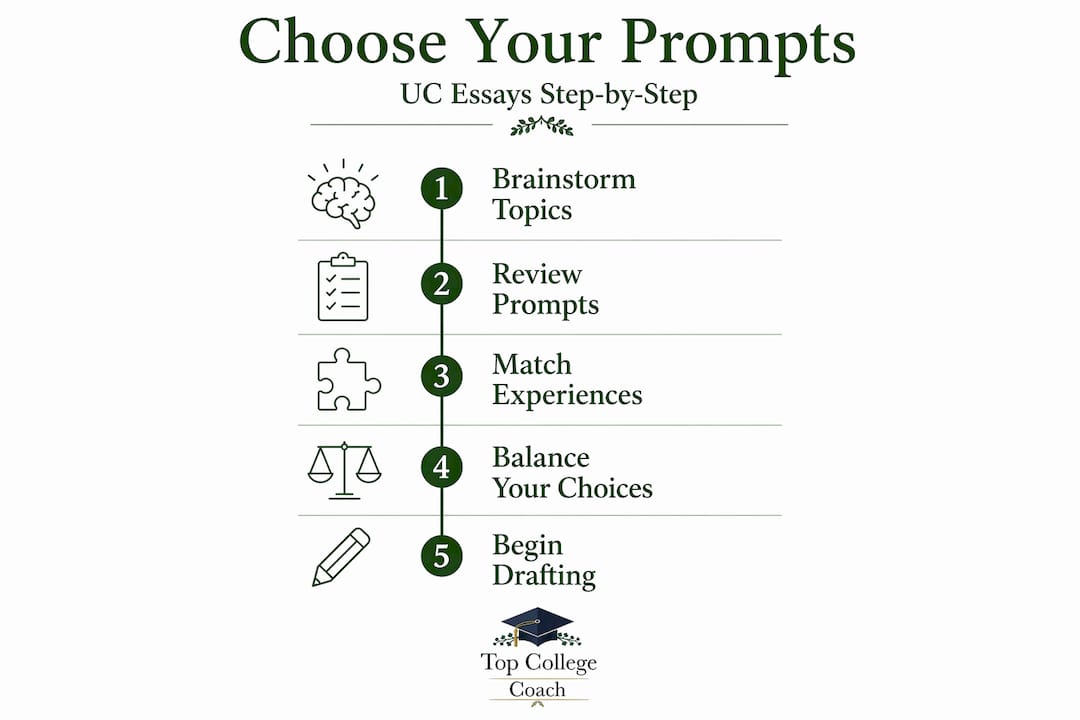
Choosing which four prompts to answer is where many students stumble. The temptation is to pick whichever ones seem most straightforward, but that often leads to generic essays. Authenticity resonates more than a polished response that could belong to anyone.
Before you write a single word, ask yourself these reflection questions:
What experiences have shaped me most in the last three to four years?
Where have I grown in ways that surprised me?
What do I spend time on that I never have to force myself to do?
When did I face a real setback, and what did I take away from it?
Is there something about me that my transcript completely misses?
Your answers will naturally point you toward the right prompts. For example, if your biggest growth moment was learning to manage a chronic illness while maintaining your grades, Prompt 4 (educational barriers) or Prompt 5 (personal achievement) would fit far better than Prompt 1 (leadership), even if you technically held a leadership role.
Avoid these common selection mistakes. First, do not choose a prompt simply because you think it sounds impressive. Second, do not repeat the same theme across multiple essays. If three of your four responses all center on the same club or activity, you are wasting the opportunity to show your range.
Pro Tip: Balance your four responses by including at least one that is academic or intellectual and at least one that is personal or emotional. This mix shows admissions officers a fuller, more three-dimensional version of you.
Writing a response that actually stands out
Once you have selected your four prompts, the writing process becomes the real challenge. Strong UC personal insight questions do not read like formal essays. They read like a confident, clear conversation.
Here is a step-by-step approach that works:
Open with a specific scene. Instead of starting with a thesis or general statement, drop the reader into a moment. “The first time I burned an entire batch of sourdough, I almost quit baking for good” is far more engaging than “I have always been passionate about baking.”
Build the middle with context and growth. Explain the challenge or experience, then move quickly to what changed for you. Admissions readers want to see your thinking, not just a timeline of events.
Close with a clear takeaway. Your final sentences should connect the story to who you are now or who you are becoming. Not “I learned a lot from this” but something specific: what you now know, believe, or do differently.
Use details that only you could write. Anyone can write about a community service trip. You are the only one who can write about the specific conversation you had with a resident at the shelter that changed how you think about poverty. Details create authenticity.
Read it out loud before you finalize. If it sounds stiff or formal when you read it, it will read that way to admissions officers too. Your voice should come through naturally.
Detailed yet concise stories help admissions committees understand applicant qualities far better than generic statements. Keep every sentence earning its place within that 350-word ceiling.
Pro Tip: After your first draft, ask someone who knows you well to read it and tell you if it sounds like you. Then ask someone who does NOT know you well to read it and tell you what they learned about you. Both perspectives matter.

For additional guidance on writing effective college essays, studying general application essay strategy can sharpen your instincts for UC writing too.
Common mistakes and how to fix them
Even strong writers make predictable errors in their University of California application essays. Knowing what to watch for saves you from submitting a draft that undersells your actual story.
The most frequent problems include:
Going off-topic. Re-read the prompt after you finish your draft. Does your response actually answer what was asked? Many students drift into storytelling and forget to connect back to the prompt’s core question.
Missing personal reflection. Describing what happened is only half the job. The “so what” is what admissions readers need. Writing off-topic or lacking reflective insight are among the most common reasons otherwise strong essays fall flat.
Using clichés. Phrases like “I want to make a difference” or “This experience changed my life” tell the reader nothing specific. Replace every cliché with a concrete detail or observation.
Drastically underusing the word count. A 180-word response to a 350-word prompt signals that you either ran out of things to say or did not take the prompt seriously. Aim for at least 300 words per response.
Relying on impressive-sounding language. Complicated vocabulary does not make an essay stronger. Precision does. Say exactly what you mean, in the clearest way possible.
To revise effectively, do not just reread your essay. Print it, read it backward sentence by sentence to catch grammar errors, and then read it forward one more time asking: “Does every sentence reveal something about me?” If any sentence could apply to any other student, revise or cut it.
What UC admissions officers actually look for
UC admissions uses a holistic review process, which means your essays are not graded in isolation. They sit alongside your GPA, course rigor, extracurriculars, and other factors. But essays carry significant weight because they reveal what numbers cannot.
The traits UC campuses consistently value are creativity, leadership, resilience, and genuine intellectual curiosity. UC essays reveal personal growth, community involvement, and academic passion, and admissions readers are specifically trained to look for those qualities in your writing.
“Strong essays often tell a story that culminates in a learned lesson or personal evolution. Admissions officers are not looking for perfection. They are looking for evidence that you think deeply, bounce back from setbacks, and contribute meaningfully to the communities around you.” — UC essay evaluation criteria
Your essays also give context that your transcript cannot. A student who earned a 3.5 GPA while working 20 hours a week to support their family tells a very different story than a student who earned the same GPA in easier circumstances. That context lives in your essays. Use it.
Application essays complement grades and test scores by showing qualities like resilience and leadership that data points simply cannot capture. Think of your four PIQ responses as your chance to become a person in the eyes of the reader, not just a profile.
My honest take on UC essays after years of this work
I have worked with hundreds of students on their UC personal insight questions, and the pattern I see most often is the same one: students spend weeks agonizing over which prompt to choose and then rush the actual writing. That is completely backward.
The prompt matters far less than the story you bring to it. I have seen students write extraordinary responses to Prompt 8 (the open-ended one most students avoid) because they had a genuinely unusual experience that did not fit anywhere else. I have also seen students choose Prompt 1 (leadership) and write the most forgettable essays imaginable because they defaulted to recapping their club president duties.
What I tell every student: write the story that you have never told anyone in quite this way before. Not the story you think colleges want. Not the one that looks most impressive on paper. The one that, when you read it back to yourself, makes you think “yes, that is actually me.”
The other thing I want you to remember is that the UC PIQs are not a test of your writing talent. They are a test of your self-awareness. Students who know themselves well, who can reflect honestly on their experiences and articulate what they learned, consistently write the most memorable essays regardless of their starting writing skill level.
Treat these essays as an opportunity for a conversation, not an audition for approval. That shift alone changes everything about how you approach the page.
— Randy Pryor
Ready to write your strongest UC essays?
Writing four compelling essays under tight word limits while managing school, activities, and everything else senior year throws at you is genuinely hard. You do not have to figure it all out alone.
At Top College Coach, we specialize in helping students just like you clarify their stories, select the right prompts, and write responses that reflect who they really are. Our counselors have helped students gain admission to UC campuses and top universities across the country, and we bring that same personalized admissions strategy to every student we work with. If you want expert eyes on your essays and a clear plan for your entire UC application, start with a free strategy session and see exactly how we can help you put your best story forward.
FAQ
How many UC essay prompts do you have to answer?
You choose 4 prompts from the set of 8 personal insight questions, and each response has a 350-word maximum. There is no minimum word count, but aim for at least 300 words per response.
What do UC admissions officers look for in essays?
UC admissions officers look for genuine stories that demonstrate personal growth, creativity, and resilience. They want to see how you think, what you value, and how you contribute to the communities around you.
Can you use the same UC essay for multiple UC campuses?
Yes. Because all UC campuses use the same application through the UC system, you submit one set of four essays that every campus you apply to will read. You do not need to write separate essays per school.
What is the biggest mistake students make on UC essays?
The most common mistake is writing a response that describes events without including personal reflection or a clear takeaway. Revising to include unique storytelling and genuine insight is the fastest way to strengthen a weak draft.
When is the UC application deadline?
The UC application for fall admission typically opens August 1st and closes November 30th. Getting your summer preparation started early gives you the most time to draft, revise, and finalize strong essays before that deadline.
Recommended
Comments