What Is a College Application Personal Statement?

A college application personal statement is a personal essay that reveals who you are beyond your GPA, test scores, and extracurricular list, giving admissions officers a direct window into your values, voice, and growth. Known formally as the college admissions essay, this piece of writing is the most personal component of your application. It is your one opportunity to speak directly to an admissions committee in your own words. While transcripts show what you have achieved, the personal statement shows who you are becoming.
At Top College Coach, we have watched students with near-perfect GPAs get passed over while students with compelling, honest stories earn spots at Ivy League and Top 20 universities. The difference is almost always the essay. Understanding what a college application personal statement requires, and what it does not, is the first step toward writing one that actually works.

What is a college application personal statement supposed to do?
The personal statement serves one primary function: it gives admissions officers context that no other part of your application can provide. Your transcript shows rigor. Your recommendations show how others perceive you. The personal statement shows how you perceive yourself, and what you do with that self-awareness.
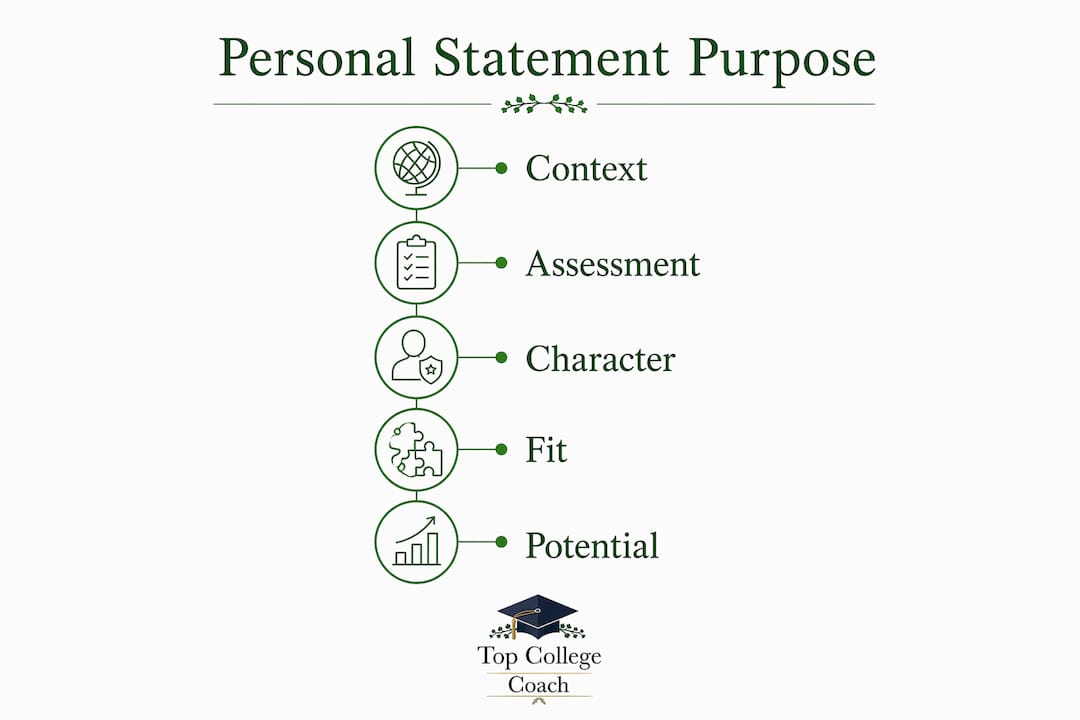
Colleges use this essay to assess fit, character, and potential. A well-written personal statement answers the unspoken question every admissions officer is asking: “Why does this student belong here, and what will they contribute?” That question cannot be answered with a GPA.
The importance of personal statement writing has grown as more students apply with strong academic profiles. When thousands of applicants have similar grades and scores, the essay becomes the differentiator. It is not a formality. It is a strategic asset.
What do colleges look for in a personal statement?
Admissions officers are not looking for perfection. They are looking for authenticity. According to College Board’s BigFuture, colleges seek a unique perspective and an authentic voice, not a polished argument or a resume in paragraph form. Here is what separates a memorable essay from a forgettable one:
A specific story, not a summary. The best essays zoom in on one moment, one relationship, or one turning point. A student who writes about the exact moment they realized their grandmother’s recipes were a form of cultural preservation will always outperform a student who writes broadly about “loving family.”
Reflection over recitation. Listing achievements is what your activities section is for. The personal statement should show what those experiences taught you, how they changed your thinking, or what questions they left you with.
A genuine voice. Admissions officers read thousands of essays. They recognize when a student is performing maturity rather than expressing it. Authenticity in tone makes the reader feel like you are right there in the room with them.
Strong writing craft. Clear sentences, precise word choice, and a logical narrative arc all signal that you can handle college-level academic writing.
Evidence of growth. The most powerful essays show a student who has changed, learned, or been challenged. Admissions officers are investing in your trajectory, not just your past.
Pro Tip: Avoid the “hero essay” trap. Writing about winning the championship or leading the club is fine, but only if the focus is on what you learned, not on the achievement itself.
How to structure and write an effective personal statement
Writing a strong personal statement is a process, not a single draft. Here is a practical framework that works for the Common App, coalition applications, and most university portals.
Brainstorm with specificity. Do not start by asking “What should I write about?” Start by listing ten specific moments from the last four years when you felt most like yourself. The best topics are rarely the most dramatic. A student who spent three summers cataloging insects in their backyard may have a more compelling story than one who climbed a mountain.
Choose one theme and commit to it. Selecting a single theme supported by one central story creates a coherent essay under 650 words. Trying to cover three different experiences fragments the narrative and dilutes the impact.
Open with a scene, not a thesis. Start in the middle of a moment. “The fluorescent light in the hospital waiting room buzzed at exactly the wrong frequency” pulls a reader in. “I have always been passionate about medicine” does not.
Build toward insight. The body of your essay should move from the specific event toward a broader reflection. What did this experience reveal about how you think, what you value, or where you are headed?
Respect the word limit. The Common App enforces a 650-word limit strictly. Essays that exceed this are truncated without warning, meaning your conclusion may simply disappear. Draft at around 620 to 630 words to give yourself a buffer.
Revise for voice, not just grammar. After your first draft, read it aloud. If it does not sound like you, revise until it does. Then ask someone who knows you well whether the essay sounds like the person they know.
Pro Tip: Treat the essay as a narrative of learning rather than a report of events. This reframe reduces writing anxiety and produces a more cohesive, meaningful result.
For a deeper look at the Common App specifically, the Common App essay guide from Top College Coach walks through every prompt with examples and revision strategies.
How do US Common App and UK UCAS formats compare?
Students applying to both American and British universities face two very different personal statement formats. Understanding the distinction early saves significant time and prevents you from submitting the wrong type of essay to the wrong system.
Feature | Common App (US) | UCAS (UK, 2026 format) |
Format | One open-ended essay | Three structured questions |
Word/character limit | 650 words | Approx. 4,000 characters total |
Focus | Personal narrative and character | Academic fit, preparation, and experiences |
Prompts | 7 optional prompts (or no prompt) | Fixed questions on course fit, qualifications, and outside education |
Tone | Personal and reflective | Academic and evidence-based |
The Common App essay is narrative-first. You choose from seven prompts or write without a prompt, and the goal is to reveal character through story. The UCAS format, updated for 2026 entry, replaced its traditional single essay with three structured questions. These address why you want to study the course, how your qualifications have prepared you, and what experiences outside formal education have shaped your readiness.
The practical implication is significant. A personal statement written for the Common App will not translate directly to UCAS. The US version centers on who you are. The UK version centers on why you are academically prepared. Students applying to both systems need two distinct drafts with different emphases.
What topics and examples work best in college personal statements?
Effective personal statements come in many forms, but the strongest ones share a common structure: a specific moment, honest reflection, and a clear connection to who the student is becoming. Here are themes that consistently produce compelling essays:
Overcoming a specific challenge. Not a generic hardship essay, but a precise account of one obstacle and the concrete steps taken to address it. A student who describes learning to advocate for themselves after a misdiagnosis tells a story that is both personal and universally resonant.
A passion pursued outside the classroom. Whether it is competitive chess, urban farming, or writing fan fiction, essays that show deep engagement with a self-directed interest reveal intellectual curiosity and initiative. These qualities matter to admissions officers at schools like MIT, Princeton, and Georgetown.
A relationship that changed your thinking. Essays built around a mentor, a sibling, or even an unlikely friendship can reveal character more effectively than any achievement-based narrative.
A moment of failure or recalibration. Admissions officers at schools like Yale and Duke have publicly stated that essays about failure, handled with genuine reflection, are among the most memorable they read.
The key across all these themes is connecting the personal story to academic and career goals without forcing the connection. If you want to study environmental science and your essay is about restoring a local creek with your scout troop, the link is organic. If you want to study finance and your essay is about the same creek, you need a stronger bridge between the story and your stated direction. For more on what top schools actually value, the college admissions insights resource from Top College Coach breaks down criteria by school type.
Key takeaways
A strong college application personal statement is built on one specific story, an authentic voice, and clear reflection on growth. Generic essays, no matter how well written, do not stand out in competitive admissions pools.
Point | Details |
Definition and purpose | The personal statement reveals character and values that grades and test scores cannot show. |
What colleges want | Admissions officers prioritize authentic voice, specific storytelling, and evidence of growth over achievements. |
Structure and word count | Choose one theme, build toward insight, and stay under the 650-word Common App limit. |
US vs. UK format | Common App uses one narrative essay; UCAS 2026 uses three structured academic questions. |
Topic selection | Specific moments, honest reflection, and a natural link to future goals produce the strongest essays. |
Why the personal statement is the part most students get wrong
I have reviewed thousands of personal statements over my career, and the most common mistake is not bad writing. It is playing it safe. Students write what they think admissions officers want to hear, and the result is an essay that sounds like every other essay in the pile.
The students who get into MIT, Duke, and Vanderbilt are not always the ones with the most dramatic stories. They are the ones who trusted their own voice. I have seen a student write an entire essay about the specific way she organized her bedroom bookshelf and earn admission to a Top 10 university. The topic was ordinary. The self-awareness was extraordinary.
The second mistake I see constantly is treating the essay as a summary of the application. Your essay should not repeat your activities list or explain your GPA. It should add a dimension that nothing else in your file can provide. Think of your application as a puzzle. Every other piece shows what you have done. The personal statement shows who you are while doing it.
My honest advice to students and parents: start earlier than you think you need to, write more drafts than feel necessary, and resist the urge to make the essay sound impressive. Make it sound true. That is what gets remembered.
— Randy Pryor, Founder of Top College Coach
Get expert help crafting your personal statement
Writing a college personal statement that genuinely stands out takes more than one draft and a grammar check. At Top College Coach, we work one-on-one with students to identify the right story, sharpen the narrative, and produce an essay that reflects their authentic voice. Our counselors have helped students gain admission to Harvard, Yale, Princeton, and every Top 20 university.
Whether you are just starting to brainstorm or you have a draft that needs serious revision, a free admissions strategy session with Top College Coach gives you a clear, personalized plan for your personal statement and your full application. Do not leave the most important essay of your academic life to chance.
FAQ
What is a college application personal statement?
A college application personal statement is a personal essay, typically 650 words for the Common App, that allows students to show character and growth beyond their academic record. It is the most personal component of a college application.
How long should a personal statement for college be?
The Common App personal statement has a strict 650-word limit. Students should draft at around 620 to 630 words, since the platform truncates essays that exceed the limit without any warning.
What should I include in a personal statement?
A strong personal statement includes one specific story or theme, honest reflection on what that experience taught you, and a clear sense of your voice and values. Avoid listing achievements or repeating information already covered in other parts of your application.
How is the US Common App essay different from the UCAS personal statement?
The Common App uses one open-ended narrative essay focused on personal character, while the UCAS 2026 format uses three structured questions focused on academic fit and preparation. Students applying to both systems need two separate essays.
When should I start writing my college personal statement?
Start brainstorming in the spring of junior year and aim to have a solid draft by early summer before senior year. This timeline allows enough revision cycles to produce an essay that genuinely reflects your best thinking and voice.
Recommended
Comments